

- Forging Ahead: How Flexible ABL Financing is Fueling Growth for U.S. Manufacturers
- SFNet Announces FY27 Leadership Appointments
- The Signal in the Survey: ABL Credit Quality as an Early Warning of Systemic Stress
- Factoring Volume Rises as Industry Outlook Strengthens, SFNet Mid-Year Survey Finds
- Frozen Food's Middle Market Is an Underserved Credit Opportunity
Protecting Collateral Liquidity Through Cyber Operational Resilience
June 15, 2026
By Alexander N.M. Niejelow and Doug Jung


Asset-based lending (ABL) is built on the premise that if a borrower is unable to repay its loan, the cash conversion of the collateral is there. But in a cyber incident, collateral may remain “there” but visibility to the lender’s collateral and its quality disappears. If a borrower can’t ship, can’t invoice, or can’t produce a trustworthy borrowing base for even a few days, collateral proceeds and AR/inventory mix will change significantly, with the resultant impact on the borrowing base leaving the Lender in the dark as to their collateral vis-à-vis their loan exposure.
Asset-based lending (ABL) is built on the premise that if a borrower is unable to repay its loan, the cash conversion of the collateral is there. But in a cyber incident, collateral may remain “there” but visibility to the lender’s collateral and its quality disappears. If a borrower can’t ship, can’t invoice, or can’t produce a trustworthy borrowing base for even a few days, collateral proceeds and AR/inventory mix will change significantly, with the resultant impact on the borrowing base leaving the lender in the dark as to their collateral vis-à-vis their loan exposure.
As a result, cybersecurity incidents are no longer peripheral technology problems, they are increasingly the fastest path to major operational issues, losing visibility to collateral details, impairment and liquidity stress.
Axiomatic to ABL is the lender’s collateral. And possession or unfettered access to collateral is 9/10th of the law. The field exam, or collateral diligence, has traditionally been the cornerstone of ABL underwriting and portfolio management, designed to diligence a variety of areas, including:
Determine that the borrower’s working capital management is commercially reasonable.
Assess whether bookkeeping and accounting for the collateral and items affecting collateral are accurate and reasonably reflect economic reality.
Identify practical issues to successful cash conversion, substance over form.
Ensure that the borrowing base reflects the lender’s collateral with all the agreed upon calculations for ineligibles, reserves and advance rates, and importantly that no other ineligibles or reserves should be in place.
What has changed, however, is the operating environment that underpins that collateral. Today’s borrowing base is increasingly digitally dependent, relying significantly on a variety of technologies to manage a business (e.g., manufacturing, customer fulfillment activities, inbound and outbound logistics, electronic invoicing, cash application tools, key reporting inputs such as AR agings and inventory perpetuals, third-party service providers that sit between the borrower and its customers).
While many of the risks field exams evaluate remain the same, those risks now coexist with a new category of exposure that can rapidly disrupt collateral integrity: operational interruption driven by cyber events. For lenders, this shift has important implications: a cyber risk assessment performed in conjunction with the field exam should no longer be an optional enhancement; it is an essential evolution of collateral due diligence.
Why Cyber Risk Is Fundamentally an ABL Liquidity Risk
ABL structures, and borrowing bases in particular, are designed to flex with working capital. But they also assume that the working capital cycle, with competent and proper management, can continue to function, even under pressure. Ransomware, destructive malware, credential compromise, IP theft, and third-party outages do not have to permanently destroy data to substantially impact collateral. A few days of disruption during a peak shipping cycle can stall invoicing, increase disputes, delay collections, and materially weaken the borrowing base often before financial statements show any deterioration. Cyber incidents break that assumption in predictable ways:
Inventory exists, but can’t move: Production shutdowns, warehouse system failures, or logistics outages can cause fast-turn inventory to stock out and slow-moving inventory to further age out. From a lender’s perspective, inventory that cannot be processed or shipped cannot be converted into AR and ultimately, cash.
Invoicing and receivables formation slow down: If systems required to pick customer orders and ship goods or generate invoices are unavailable, or if data integrity is in doubt, borrowing base integrity collapses, and eligible receivables simply stop forming, even if demand remains strong. Service levels drop, increased mis-picks and mis-ships occur with the resultant customer dissatisfaction or, worse, permanent or long-term loss of customers—affecting AR dilution, cash collection timing/levels and sales lasting well beyond the remediation of the cyber issue.
Emergency spending accelerates: Incident response costs, expedited freight, system rebuilds, legal and regulatory expenses often create immediate and unplanned cash drains. Customer remediation efforts will increase both dilution and past dues, thereby deteriorating collateral quality.
Operational Resilience: The Missing Link Between Cyber and Credit
Cybersecurity discussions often focus on prevention: firewalls, endpoint protection, training, and patching. Those controls matter, but for lenders, operational resilience matters more. Resilience is the borrower’s demonstrated ability to continue or rapidly restore critical operations during disruption.
In ABL terms, operational resilience answers practical questions lenders care about:
How quickly can the borrower resume shipping and invoicing?
Can the borrower produce reliable AR agings and inventory perpetuals and related reports during an outage, even manually?
Are backups tested and prioritized for critical functions?
What third-party dependencies exist?
Has the borrower’s transactional accounting and finance team been meaningfully involved in incident response planning?
A borrower with strong cyber hygiene but weak recovery capabilities may still experience a prolonged liquidity event. Conversely, a borrower with well-tested recovery processes and clear operational fallbacks may sustain collateral performance even through a significant incident. The difference is resilience, and it is measurable.
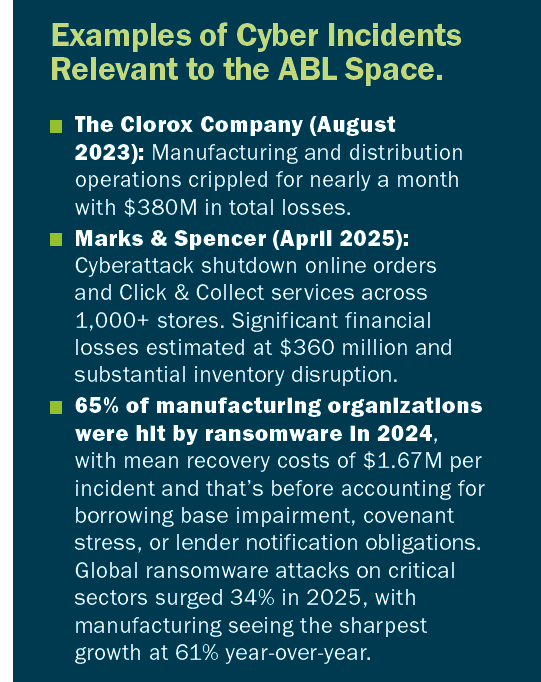
A Competitive Advantage for ABL Lenders
ABL has long delivered strong loss performance because of its discipline: constant collateral monitoring including field exams, early warning signals, and rapid intervention when metrics deviate. In a market where operational disruption is increasingly the catalyst for financial distress, lenders that can evaluate and price collateral resilience, not just collateral value, will make better credit decisions, intervene earlier, and preserve capital more effectively.
Cyber risk has become a first-order driver of borrowing base reliability because it directly threatens the systems and processes that create, operationalize, and monetize collateral.
Conducting a cyber risk assessment in conjunction with the field exam, focused on operational resilience and collateral-to-cash continuity, allows lenders to see liquidity risk before it materializes—and to structure accordingly. In today’s environment, that is not merely prudent. It is the next standard of care for sophisticated ABL platforms.
Please click here to view the article as it is published in The Secured Lender magazine.
About the Author



© 2026 Secured Finance Network

