

- Forging Ahead: How Flexible ABL Financing is Fueling Growth for U.S. Manufacturers
- SFNet Announces FY27 Leadership Appointments
- The Signal in the Survey: ABL Credit Quality as an Early Warning of Systemic Stress
- Factoring Volume Rises as Industry Outlook Strengthens, SFNet Mid-Year Survey Finds
- Frozen Food's Middle Market Is an Underserved Credit Opportunity
Eleven Titans, One Zoom Call, and a Forecast That Was Almost Entirely Wrong
May 28, 2026
By Tom Goldblatt

What happened on May 12, 2020, at the peak of pandemic uncertainty, when legends of middle-market finance got on a video call to compare notes?
I called everyone three weeks ahead. Almost everyone said yes.
That alone should have told me something was off about the world.
In a normal year, I could not have assembled this group in one room if I had a year to plan it and a private jet to fly them in. They were too busy. They were never in the same city. Their calendars were locked solid for months. But it was not a normal year. It was May 2020, and the world had stopped. For a brief stretch of weeks, the people normally hardest to reach were suddenly the easiest to reach. I picked up the phone, made the asks, and one by one they said yes.
On the afternoon of May 12, eleven squares populated my screen.
I have hosted a lot of roundtables. I have never hosted one like this.
The Room
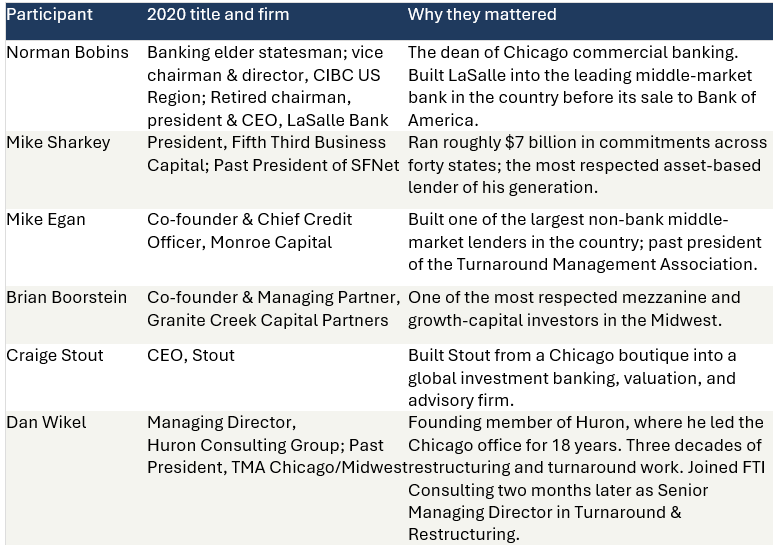
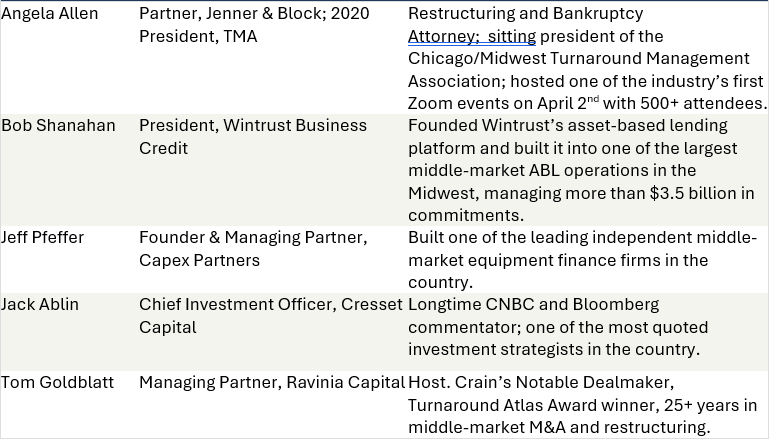
Someone called it the “Moonshot Zoom Meeting.” The name stuck. Six years later, it still feels right
The World That Made the Call Possible
We were eight weeks into lockdown. Almost nothing about the world looked the way it had looked in February.
The S&P 500 had peaked at 3,386.15 on February 19. It bottomed at roughly 2,237 on March 23, a thirty-four percent decline in thirty-three days, the fastest bear market in history, more violent than 1987 or 1929. Then it began rallying for reasons no one on this call could account for. By May 12 it had clawed back close to twenty-seven percent off the lows.
Office occupancy in major U.S. cities had collapsed. Kastle Systems, which tracks card-swipe entries across its portfolio of buildings in ten major metro areas, had shown a near-vertical drop in mid-March. By the week of our call, occupancy was hovering around fifteen percent of the February baseline. The towers stood dark. Calendars were empty. Nobody was flying anywhere.
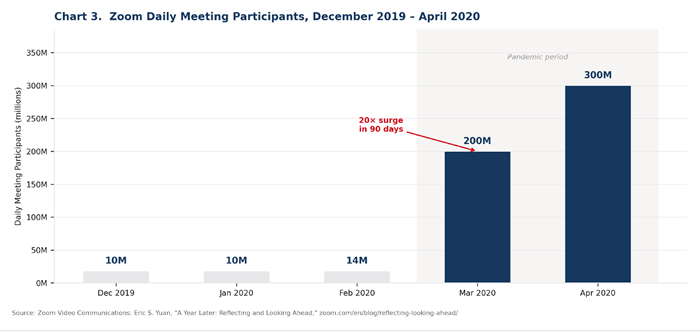
Zoom had grown from ten million daily meeting participants in December 2019 to two hundred million by April 2020. By the end of April, it was three hundred million. A platform almost no one in finance had used six months earlier was suddenly the only way any of us could see one another’s faces. (See Eric Yuan's Zoom blog post here for details.)
The financial industry runs on handshakes, breakfasts, and golf. All of it had stopped. The information channels we depended on, the chance hallway conversation, the dinner tablemate at an ACG event, the quick call from a banker friend who had just heard something, had simply gone dark. Everyone wanted to know what the smart people were seeing. Nobody could find out.
I had latched onto Zoom early. Most of my peers were treating video calls as a poor substitute for the real thing. I noticed something different. The very people I had been chasing for years were now answering their own phones. The pandemic had inverted the calculus of access. So, I aimed high.
The Call
Bob Shanahan opened. He had built Wintrust Business Credit from the ground up and was watching the firm’s downtown asset-based portfolio with the kind of attention only a founder gives. He framed the moment carefully. Lenders, he said, were underwriting with what he called a “glass half full” attitude, expecting things to improve by June. Then he hung the warning on the room.
“Some of those sectors are not going to get better. And then pretty soon we’re going to have to start shifting our angles from glass half full to glass half empty.” ~Bob Shanahan, Wintrust Business Credit
Brian Boorstein said the quiet part out loud, almost offhandedly.
"We are all underwriting the way in which this disease rolls out. It's almost impossible to know right now what this disease is going to do." — Brian Boorstein, Granite Creek Capital Partners
Granite Creek's answer was structural. Hard-money asset deals on one side, deeply discounted business-model bets on the other. Bi-modal by design, because a moment that offers no clarity rewards flexibility, not conviction.
Dan Wikel went next, and he gave us the line that captured the entire afternoon’s intellectual posture:
“I thought I had a crystal ball. Then I didn’t. And I did.” ~Dan Wikel, Huron Consulting Group
Dan’s firm had been frantically busy in late March and early April. Boards were calling lawyers. Lawyers were calling restructuring advisors. Then it had all gone quiet. Forbearances had been put in place. Quarter-end was coming. He was bracing for the dam to break.
Norman Bobins finally got himself unmuted and brought the banker’s view. The banks were taking enormous reserves. The Fed was actively pressing them to be lenient: push out payments, waive covenants, restructure rather than foreclose. He thought that posture would hold for at least six months. He flagged retail as the sector to watch and predicted that consumer habits had permanently shifted online. He was right about that. He was wrong, like all of us, about what the policy response would do to the rest of the picture.
Then came Mike Sharkey, calling from Sedona. He had just done a full portfolio review across his book in forty states. He gave the room the single most prescient observation of the afternoon. He admired the design of the Paycheck Protection Program. He thought it was, in his word, brilliant. But he framed the trap precisely:
“We’re kind of in the calm before the storm right now. Unless there’s another round of PPP, this could be the calm before the storm.” ~Mike Sharkey, President, Fifth Third Business Capital
He was right about the calm. He was wrong, like everyone else, about the storm, because Congress would deliver another round of PPP, and another, and another. The storm never came because the money never stopped.
Sharkey also dismantled, in real time, the Federal Reserve’s $600 billion Main Street Lending Program. The Fed wanted to be pari passu with existing debt. Sharkey did the math out loud. If he had a fully covered $1 million loan and the Fed layered in another million, he was instantly $800,000 underwater on a previously safe loan. The structure didn’t work.
He had told the Fed exactly that the previous Friday. The program would, in fact, fail to gain traction. It became one of the era’s notable policy disappointments.
Craige Stout, calling from Dallas, gave us the leading indicator. He had gone from sixty-two active deals in his book on March 10 to thirty-two on May 12. Roughly half. But then Craige tossed off, almost in passing, what would turn out to be the most prescient long-term call on the entire afternoon:
“There’s no question, our footprint is about 200,000 square feet of space. Over the next ten years, we’ll cut that to 150 to 125. No question in my mind.” ~Craig Stout, CEO, Stout.
Six years later, with U.S. office occupancy still hovering near fifty percent of pre-pandemic levels, Craige looks like a prophet. Almost everyone else on the call assumed offices would come back within months. Craige assumed they wouldn’t. He was right.
Jeff Pfeffer described an industry holding its breath. Capex had raised the floor on company size, was avoiding hospitality and retail, and was watching the automation and onshoring trends he’d been tracking for two years suddenly accelerate.
Angela Allen, speaking as a leading bankruptcy lawyer and the sitting TMA president, gave the room the restructuring view. Seconding Norman’s comments that “banks are encouraged right now to work with borrowers”, she noted that although “the bankruptcy courts are open and we're doing Zoom hearings and Zoom depositions and Zoom evidentiary hearings, [ ] the goals of bankruptcy are to get financing, do a deal, do a sale, and in a worst-case scenario do a liquidation… Art Van and a number of those cases were put on what they call ‘mothball motions,’ where they just say, ‘Bankruptcy is not cheap. We don't want to incur any more professional fees. This case is just going to sit until we can sell Art Van furniture again.
“A lot of people need to be in bankruptcy, but there’s no point in going in right now.” ~Angela Allen, Jenner & Block
The dominoes never fell. The few that did were quickly propped back up by the policy response.
Jack Ablin closed the substantive remarks with the single observation that captured the divergence between Wall Street and Main Street. Electricity usage was down nine percent year over year, consistent with the worst quarter in modern economic history. And yet equities had rallied thirty percent off the March 23 lows. Capital markets had decoupled from the real economy. The Fed was the reason. He flagged the historical comparison: the last time U.S. debt-to-GDP hit 120 percent was 1945, and the top marginal tax rate then was ninety percent. He wasn’t predicting a return there. He was reminding the room that policy has long tails.
I ran a poll near the end. How long until a material amount of healthy M&A activity returns? Sixty-three percent said six to twelve months. Twenty-five percent said more than twelve months. I said three years.
Everyone was wrong.
What Actually Happened
By 2021, global M&A volume hit roughly $5.1 trillion, a fifty percent jump from 2020 and the highest annual total since record-keeping began. The market we all assumed would take years to recover took months.
The bankruptcy wave never came. The distressed market every restructuring professional was bracing for largely failed to materialize. The Main Street Lending Program failed for exactly the reasons Sharkey laid out.
PPP, designed as eight weeks of bridge financing, became multiple trillions across multiple rounds. Inflation, barely mentioned on our call, surged to forty-year highs by 2022. Interest rates, assumed to remain near zero indefinitely, spiked to levels not seen in decades. And offices, as Craige alone seemed to anticipate, never came back to anything close to normal.
We were not wrong because we were unintelligent. This was as smart and experienced a group as could be assembled in our industry. We were wrong because nobody in May 2020 had a model that incorporated the speed, scale, and political will of the policy response that was about to unfold. We were forecasting a 2008-style cycle. We got something none of us had ever seen.
What I Take From It
What makes the transcript worth keeping is not the predictions. It is the candor. None of us was performing with certainty. We were practitioners admitting, in real time, what we did not know. Dan’s “I had a crystal ball, then I didn’t, and I did.” Brian’s acknowledgment that we were betting on the disease itself. Norman, after a long career of being asked for crystal-ball forecasts, simply describing what he was seeing and refusing to predict beyond it. That kind of honesty is rare in any room of senior practitioners. It was possible that afternoon because none of us had any choice. There was no script, no comfortable narrative, nothing to fall back on.
The other thing I take from it is a small lesson about access. Crises usually destroy ordinary access. But for a window of perhaps six weeks in the spring of 2020, the people normally hardest to reach were suddenly the easiest. I was lucky enough to recognize that early and to act on it. The people who showed up that afternoon were generous enough to say yes. Six years later, we will not be in that configuration again. We can’t be.
We called it “The Moonshot” as a joke. It turned out to be the right word.
This article reflects the personal observations and recollections of the author.
Information attributed to other participants is drawn from a May 12, 2020, video roundtable hosted by Ravinia Capital. Information has not been independently verified by Ravinia Capital, and recipients should perform their own diligence before relying on any of the views expressed. Nothing in this document constitutes investment, legal, tax, or accounting advice, or an offer or solicitation to buy or sell any security. Forward-looking statements are inherently uncertain and actual results may differ. Ravinia Capital LLC makes no representation or warranty as to the accuracy or completeness of any information herein.
About the Author




© 2026 Secured Finance Network

