

- The Contra Nobody Is Watching: Tariff Refunds Through an ABL Due Diligence Lens
- The Perils of Dual Engagements
- Forging Ahead: How Flexible ABL Financing is Fueling Growth for U.S. Manufacturers
- SFNet Announces FY27 Leadership Appointments
- The Signal in the Survey: ABL Credit Quality as an Early Warning of Systemic Stress
The Contra Nobody Is Watching: Tariff Refunds Through an ABL Due Diligence Lens
October 13, 2026
By Donald F. Clarke

U.S. Customs and Border Protection (CBP) is now refunding tariffs imposed under the International Emergency Economic Powers Act (IEEPA), which the Supreme Court ruled unlawful. Most of the commentary treats this as good news for importers. For asset-based lenders, it raises a different question, one that belongs in due diligence: Who is actually entitled to the money?
A Simple Scenario
A borrower imports goods from China and pays the tariff. It passes that cost to its customer, who now owes a receivable that sits in our borrowing base. The tariff is later ruled unlawful, and the borrower receives a refund. We have seen this firsthand, with one client receiving a seven-figure refund.
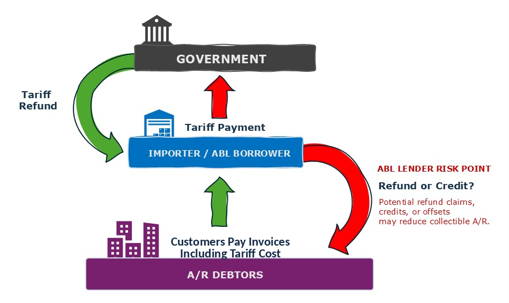
Figure 1. How a tariff moves through an ABL borrower. The lender's exposure sits on the return leg, where refund claims, credits or offsets can reduce collectible receivables.
Does the borrower keep it, or does part of it belong to the customers who paid it through their invoices?
The answer is not settled. The refund goes to the importer of record, but customers who bore the cost have begun to argue that the importer should not be paid twice. Their position is strongest where the tariff appeared as its own line on the invoice and weakest where it was folded into a negotiated price. Contract language will matter a great deal.
A lender does not need to resolve that debate. It needs to recognize that the debate exists inside its collateral.
The Implicit Contra
ABL professionals know the contra well. When an account debtor is also a creditor of the borrower, the receivable is worth less than its face amount, because the debtor can offset one against the other.
A tariff refund can create a contra that nobody booked. The borrower may owe money back to the same customers whose receivables we are advancing against. Today that obligation is invisible. It becomes explicit the moment a customer learns that the borrower received a refund of duties the customer paid for and reduces its payment accordingly.
In a liquidation, the effect is sharper. A customer does not need to win a claim against the estate. It can simply withhold payment on the receivable and assert that it was already overcharged. The lender collecting the receivable meets that defense head-on.
Our Position
Our position is that these refunds should ultimately be passed back to the account debtors of the importer the lender is financing. The money reflects what customers, and in many cases the consumers behind them, paid through their invoices. How that plays out will take years to see, and we do not claim to know the outcome.
In the meantime, the importer should not treat the refund as a cash windfall. It should set the funds aside pending future claims, especially from the account debtors whose receivables are pledged to the lender as collateral.
For the lender, we list all refunds as a separate line item below the availability line, as an implicit contra, until the question is resolved.
What It Looks Like in Availability
Figure 2 shows the same borrower under two calculations. Both start from a borrowing base built on eligible receivables and inventory. The first calculation reflects ABLC's policy. It deducts ordinary reserves and, below the availability line, the estimated refund as an implicit contra. The existing lender's calculation carries a permanent availability block and no refund line.
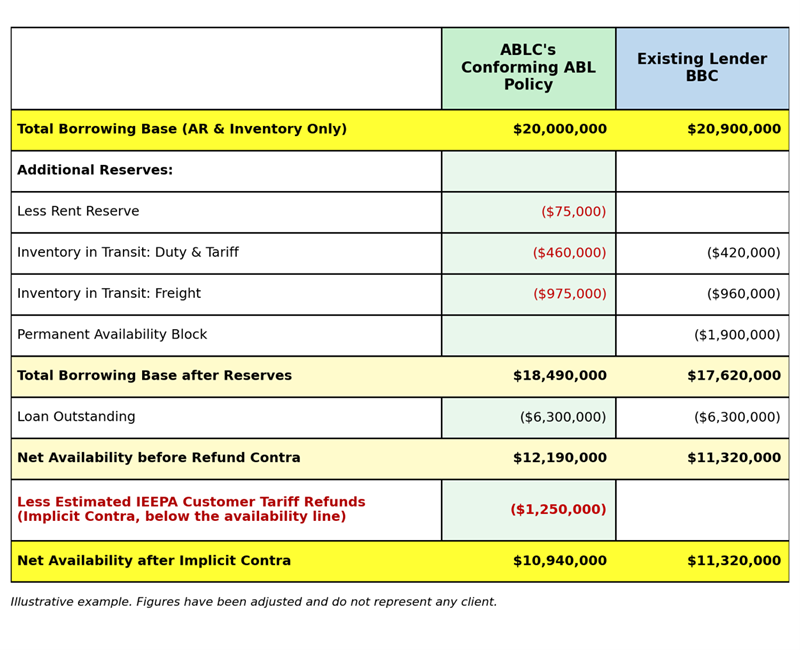
Figure 2. Illustrative availability comparison. Figures are adjusted and do not represent any client.
The refund contra in Figure 2 is $1.25 million, about seven percent of the borrowing base after reserves, and it is the line that changes the answer. Without it, our approach shows more availability than the existing lender's calculation. With it, less. The difference is money the borrower may have to give back, and a lender who advances against it is lending against cash that may not be the borrower's to keep.
The Accounting Follows the Same Logic
If part of the refund is owed to customers, it is not income to the borrower. In our view, the borrower should recognize the refund receivable and the corresponding obligation together, and should not present the full amount as earnings when the cash arrives. Lenders should watch for this in covenant calculations, because a refund booked as income can overstate results and support distributions the borrower may later need to reverse.
What Due Diligence Should Do
The response starts with asking the right questions early.
- Was the borrower the importer of record?
- Did it pay tariffs, and were they billed to customers as a separate charge?
- What do the customer agreements say about duties and refunds?
- Has a refund been filed or received?
Size the exposure. Identify which customers could claim a share, and how concentrated the risk is.
Carry the contra from filing. The exposure exists once the borrower files for the refund. At that point we list the estimated amount below the availability line, and the borrower should record the obligation once it knows the amount. That protects the lender if the money has to be paid back.
Control the cash. Refund proceeds should go through the lender's blocked account, and distributions should be restricted until ownership of the funds is clear.
The Bottom Line
None of this is a prediction that customers will win. It is a recognition that the risk is real, that it is contingent, and that few lenders are pricing it. A lender that raises it now sets the reserve on its own terms. A lender that waits may find it during a workout, after the money is gone.
Disclaimer
This article is intended for general industry discussion and does not constitute legal or accounting advice. Specific tariff-refund, customer-claim and collateral questions should be evaluated with appropriate legal and accounting professionals.
About the Author




© 2026 Secured Finance Network

