
TSL Express Daily News
The Secured Lender
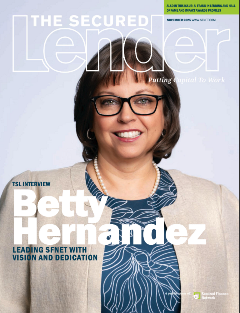
SFNet's The 81st Annual Convention Issue
Intro content. Orci varius natoque penatibus et magnis dis parturient montes, nascetur ridiculus mus. Curabitur iaculis sapien sagittis, accumsan magna ut, blandit massa. Quisque vehicula leo lorem, a tincidunt eros tempor nec. In quis lacus vitae risus egestas tincidunt. Phasellus nulla risus, sodales in purus non, euismod ultricies elit. Vestibulum mattis dolor non sem euismod interdum.
-
Top 5 Apps for Organizing
Mar 7, 2019If you’re like most of us, we try to stay organized in business and life, but it gets increasingly complicated…
-
The Importance of Stretching
Mar 7, 2019Every personal trainer and athletic coach I have ever worked with has stressed the importance of stretching. When working out…
-
SFNet's 40 Under 40 Award Winners Panel Recap
Mar 6, 2019Moderator: Samantha Alexander, regional underwriting manager, Wells Fargo Capital Finance’s Corporate Asset Based Lending group and 2016 CFA 40 Under…
-
SFNet's Inaugural YoPro Leadership Summit
Mar 6, 2019The Secured Finance Network brought together the next generation of commercial finance leaders for a full day of learning and…
-
It’s a Marathon, Not a Sprint
Aug 22, 2018I was recently invited to participate in an executive panel to answer questions from a credit training class comprised of...
-
It’s Not Too Late – Five Member Benefits to Cash In On Now
Aug 1, 2018As we hit the half way mark on calendar year 2018, it is a good time to take stock and…
-
It’s Time To Break Up With Your Phone
Jul 18, 2018Do I have your attention? Let’s be honest here: do you have the attention span to read this article? Compared…
-
Lien Management – What You Need to Know
Jun 6, 2018UCC filing is the cornerstone of all loans and every lien portfolio...
-
Potential Impacts of Blockchain on Commercial Lending
Jan 15, 2018By Raja Sengupta, Executive Vice President and General Manager, Wolters Kluwer’s Lien Solutions When it comes to the rising importance…
-
How to be a Good Leader
Dec 5, 2017I know what you’re thinking…another article about how to be a good leader? The short answer is yes…but this time,…
-
Fintech and Due Diligence – Disruptors and Established Firms Evolve
Oct 30, 2017The fintech sector has gone through a number of manifestations in the past two decades.
-
A Commercial Banker’s Tickler Transition Plan
Oct 18, 2017Just do a keyword search for “bank tickler,” and you’ll quickly realize that banks are still heavily reliant on manual…
-
Understanding and Developing Your Personal Brand: Four Steps to a More Intentional Career Progression
Sep 5, 2017It is imperative for individuals to have a general idea about their future career aspirations, just as companies should have clearly defined strategies.
-
Selecting a Technology Vendor: 3 Questions to Ask
Jul 5, 2017As with anything else at your bank, selecting a technology vendor can be a challenging decision. Users from across different…
-
Why Back-Office Lending Automation Enhances Customer Satisfaction
Apr 25, 2017Every bank strives to keep its customers happy. Of course, some institutions are better at achieving this goal than…
-
The Lost Art of the Loan Purchase
Mar 2, 2017Purchasing a loan directly from a bank whether at par or discount is a not-often-used technique that is easily…
-
Audit Prep: Why a Paperless Approach Makes Sense
Feb 15, 2017How much time does your financial institution spend preparing for audits? We recently surveyed 187 community banks, and the results…
-
Back Office Support Services: Helping you approve more clients
Feb 7, 2017How many times have you come across a potential client who’s financials are either not up to date, not accurate,…
-
“All Assets” is the Key When Drafting UCC-1 Financing Statement Collateral Descriptions
Jan 30, 2017Even when prepared by outside or in-house counsel, many lenders pay close attention to draft UCC financing statements before they…
-
Paper Loan Files: Does Your Bank Know the True Cost?
Jan 12, 2017Sure, there’s a tangible cost associated with deploying an electronic loan imaging system. Software, support, and scanning hardware are just…
.jpg?sfvrsn=f1093d2a_0 "#3 -_ 1 (1)")
September 11, 2023
Source: American Bankers Association
WASHINGTON — Despite an expected loss of momentum in U.S. economic growth over the next few quarters, the U.S. economy is likely to dodge a recession, according to the latest forecast of the American Bankers Association’s Economic Advisory Committee.
The committee, composed of 14 chief economists from some of North America’s largest banks, sees real economic growth slowing from 2.1% annualized during the first three quarters of 2023 to less than 1.0% annualized over the following three quarters. Momentum then improves slightly in the latter part of 2024, although the pace of activity remains below potential, according to the committee.
While the median committee forecast does not include any quarterly contractions, considerable concerns about a mild recession remain. Recession risks center primarily around the delayed impact of monetary tightening, deteriorating credit availability, and high credit costs, but also include event risks such as a prolonged government shutdown or renewed flaring of geopolitical tensions. The group consensus is that near-term recession risks have come down but are still significant for 2024, approaching 50%.
Consistent with slowing growth, the group expects various measures of inflation to ease close to the Federal Reserve’s target. The committee’s forecast is that consumer inflation will decline from around 4% annualized over 2023 to just above 2% in 2024.
“The odds of the Fed achieving a soft landing look much better today than they did six months ago,” said Simona Mocuta, committee chair and chief economist at State Street Global Advisors. “However, the battle against inflation is not yet won, so the Fed must remain vigilant. At the same time, there is a better balance between supply and demand across the board, in goods, services and labor markets. This helps the ongoing disinflation process.”
The group noted that household spending has been supported by robust employment gains and an improvement in real disposable income. However, this resilience will fade amid the high cost of credit, the exhaustion of excess savings and weaker job growth.
Business investment is also set to slow, although pockets of strength exist, particularly in areas of the economy benefitting from government policy initiatives such as chips and EV manufacturing. Businesses have been preparing for a general economic slowdown by reducing inventory accumulation and hiring. Profit margins are expected to remain under pressure from rising labor costs, tightening credit availability and diminishing pricing power.
Bank chief economists see evidence of modest labor market easing. The pace of anticipated job creation slows from over 200,000 per month in 2023 to just about 70,000 in 2024. Wage inflation—currently too high to be consistent with the 2.0% inflation target—moderates further as a result. The committee sees the unemployment rate rising to 4.4% by the end of 2024.
The consensus view of the committee is that the Federal Reserve will leave the target federal funds rate range unchanged until next May, then reduce it by 100 basis points before the end of 2024.
“Given both demonstrated and anticipated progress on inflation, the majority of the committee members believe that the Fed’s tightening cycle has run its course,” said Mocuta.
The committee expects 10-year Treasury yields to slip back from over 4% at present to near 3.6% at the end of next year, and 30-year mortgage rates to retreat from near 8% to near 6% over the same period.
Following six consecutive quarterly declines, the committee sees residential investment bottoming out and improving slightly through 2024. However, the group foresees a modest correction in home prices on a national average basis until the fourth quarter of 2024, when prices will begin to recover.
“After a dramatic decline, things have stabilized in housing,” said Mocuta. “Despite high mortgage rates, the demand is there.”
View detailed EAC forecast numbers.
The 2023 ABA Economic Advisory Committee includes:
- EAC Chair Simona Mocuta, chief economist, State Street Global Advisors, Boston;
- Bill Adams, SVP and chief economist, Comerica Bank, Dallas;
- Scott Anderson, managing director and chief U.S. economist, BMO, San Francisco;
- Beth Ann Bovino, chief economist, U.S. Bank, Brooklyn, N.Y.;
- Beata Caranci, SVP and chief economist, TD Bank Group, Toronto;
- Augustine Faucher, SVP and chief economist, PNC Financial Services Group, Pittsburgh;
- Peter Hooper, managing director and vice chair of research, Deutsche Bank, New York;
- Tendayi Kapfidze, managing director and chief corporate economist, Wells Fargo & Co., New York;
- Bruce Kasman, managing director and chief economist, JPMorgan Chase & Co., New York;
- Christopher Low, chief economist, First Horizon National Corp’s FTN Financial, New York;
- Richard Moody, SVP and chief economist, Regions Bank, Birmingham, Ala.;
- Carl Tannenbaum, EVP and chief economist, The Northern Trust Company, Chicago;
- Luke Tilley, executive vice president and chief economist, Wilmington Trust Investment Advisors, Wayne, Pa.; and
- Ellen Zentner, managing director and chief U.S. economist, Morgan Stanley, New York.
About the American Bankers Association
The American Bankers Association is the voice of the nation’s $23.5 trillion banking industry, which is composed of small, regional and large banks that together employ more than 2.1 million people, safeguard $18.6 trillion in deposits and extend $12.3 trillion in loans.


