
TSL Express Daily News
The Secured Lender
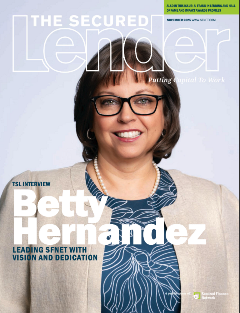
SFNet's The 81st Annual Convention Issue
Intro content. Orci varius natoque penatibus et magnis dis parturient montes, nascetur ridiculus mus. Curabitur iaculis sapien sagittis, accumsan magna ut, blandit massa. Quisque vehicula leo lorem, a tincidunt eros tempor nec. In quis lacus vitae risus egestas tincidunt. Phasellus nulla risus, sodales in purus non, euismod ultricies elit. Vestibulum mattis dolor non sem euismod interdum.
-
Top 5 Apps for Organizing
Mar 7, 2019If you’re like most of us, we try to stay organized in business and life, but it gets increasingly complicated…
-
The Importance of Stretching
Mar 7, 2019Every personal trainer and athletic coach I have ever worked with has stressed the importance of stretching. When working out…
-
SFNet's 40 Under 40 Award Winners Panel Recap
Mar 6, 2019Moderator: Samantha Alexander, regional underwriting manager, Wells Fargo Capital Finance’s Corporate Asset Based Lending group and 2016 CFA 40 Under…
-
SFNet's Inaugural YoPro Leadership Summit
Mar 6, 2019The Secured Finance Network brought together the next generation of commercial finance leaders for a full day of learning and…
-
It’s a Marathon, Not a Sprint
Aug 22, 2018I was recently invited to participate in an executive panel to answer questions from a credit training class comprised of...
-
It’s Not Too Late – Five Member Benefits to Cash In On Now
Aug 1, 2018As we hit the half way mark on calendar year 2018, it is a good time to take stock and…
-
It’s Time To Break Up With Your Phone
Jul 18, 2018Do I have your attention? Let’s be honest here: do you have the attention span to read this article? Compared…
-
Lien Management – What You Need to Know
Jun 6, 2018UCC filing is the cornerstone of all loans and every lien portfolio...
-
Potential Impacts of Blockchain on Commercial Lending
Jan 15, 2018By Raja Sengupta, Executive Vice President and General Manager, Wolters Kluwer’s Lien Solutions When it comes to the rising importance…
-
How to be a Good Leader
Dec 5, 2017I know what you’re thinking…another article about how to be a good leader? The short answer is yes…but this time,…
-
Fintech and Due Diligence – Disruptors and Established Firms Evolve
Oct 30, 2017The fintech sector has gone through a number of manifestations in the past two decades.
-
A Commercial Banker’s Tickler Transition Plan
Oct 18, 2017Just do a keyword search for “bank tickler,” and you’ll quickly realize that banks are still heavily reliant on manual…
-
Understanding and Developing Your Personal Brand: Four Steps to a More Intentional Career Progression
Sep 5, 2017It is imperative for individuals to have a general idea about their future career aspirations, just as companies should have clearly defined strategies.
-
Selecting a Technology Vendor: 3 Questions to Ask
Jul 5, 2017As with anything else at your bank, selecting a technology vendor can be a challenging decision. Users from across different…
-
Why Back-Office Lending Automation Enhances Customer Satisfaction
Apr 25, 2017Every bank strives to keep its customers happy. Of course, some institutions are better at achieving this goal than…
-
The Lost Art of the Loan Purchase
Mar 2, 2017Purchasing a loan directly from a bank whether at par or discount is a not-often-used technique that is easily…
-
Audit Prep: Why a Paperless Approach Makes Sense
Feb 15, 2017How much time does your financial institution spend preparing for audits? We recently surveyed 187 community banks, and the results…
-
Back Office Support Services: Helping you approve more clients
Feb 7, 2017How many times have you come across a potential client who’s financials are either not up to date, not accurate,…
-
“All Assets” is the Key When Drafting UCC-1 Financing Statement Collateral Descriptions
Jan 30, 2017Even when prepared by outside or in-house counsel, many lenders pay close attention to draft UCC financing statements before they…
-
Paper Loan Files: Does Your Bank Know the True Cost?
Jan 12, 2017Sure, there’s a tangible cost associated with deploying an electronic loan imaging system. Software, support, and scanning hardware are just…
.jpg?sfvrsn=f1093d2a_0 "#3 -_ 1 (1)")
January 10, 2022
Source: Sourcing Journal
Fashion is one of the least-regulated industries. A first-of-its-kind bill introduced in New York state on Friday is fighting to hold the biggest brands accountable for their impacts on people and the planet.
Sponsored by State Senator Alessandra Biaggi and Assemblywoman Anna R. Kelles, the Fashion Act, also known as Assembly Bill A8352, has powerful backing, including Environmental Advocates New York, the Natural Resources Defense Council, the New Standard Institute, the New York City Environmental Justice Alliance, designer Stella McCartney and supermodel-icon-turned-sustainability-champion Amber Valletta.
All agree that apparel and footwear retailers that make at least $100 million in revenue and conduct business in New York must map at least half of their supply chains, disclose their environmental and social impacts and set binding science-based targets to ensure that they’re reducing their greenhouse-gas emissions in line with the Paris Agreement’s goal of limiting temperature increases to 1.5 degrees Celsius above pre-industrial levels. Companies will also be required to divulge the annual volume of material produced, broken down by type, such as polyester or cotton, as well as the median pay of workers as measured against local minimum and living wages.
“The Fashion Act is a critical tool to both avoid our human-caused climate crisis and end fashion’s race to the bottom of labor exploitation,” Maxine Bédat, director of the New Standard Institute, said at a press conference introducing the bill. “And in so doing [we] will make New York a fashion leader really fit for the 21st century. We often talk about innovation as an electronic product, but as a lawyer working with some really brilliant legislators, I’m here to say the legislative innovations are perhaps even more important as we set up the rules of the game that can allow the planet, its people, the fashion industry and New York to thrive.”
Bédat described the Fashion Act as a “New York bill with a global reach,” meaning it will affect the Boohoos and Balmains of the world alike. Its broad mandate makes it more similar to the mandatory, though non-industry-specific due-diligence laws that are percolating across Europe than California’s recently passed Garment Worker Protection Act, which specifically guards against wage theft. Both the environmental and social facets of the bill are critical to the overall concept of “sustainability” that brands have been keen to cleave to, she said. In some cases, they’re one and the same, especially with fashion responsible for anywhere between 2 percent to 10 percent of the world’s annual carbon budget.
“The local effects of the climate crisis are disproportionately felt by disadvantaged communities,” Bédat said. “As time goes on, they will suffer the worst impacts of climate change unless we recognize that fighting climate change and environmental justice are inextricably linked.” It’s for this reason that the bill will come with a “meaningful” enforcement provision that fines offending companies 2 percent of their revenues for non-compliance, with proceeds going to disadvantaged communities.
New York has a “moral responsibility” to take the lead in mitigating the fashion industry’s social and environmental repercussions, said Biaggi, a Democrat who represents the 34th district of the Empire State. She said the bill will now make its way to the Senate and Assembly committees for budget negotiations, with a vote anticipated in late spring.
“For really far too long, the fashion industry has operated in somewhat of a black box with little accountability, and frankly, without adequate federal legislation to take action on climate justice,” she said, noting how unprecedented it is to draft a measure that addresses so many systemic problems endemic to a single industry. “What this means for New York is that we have an opportunity to really lead the way, and it is not hyperbolic to say that our state and our country and our world’s future depends on all of us.”
McCartney, one of sustainable fashion’s leading voices, said being “truly modern” means initiating and embracing change. “Fashion is one of the most harmful industries to the planet,” she said in a statement. “Collectively, it’s crucial that we, as an industry, commit now to taking measurable action towards mitigating our impact for a more sustainable, ethical and mindful future. The Fashion Act is an example of a step towards a better, more regulated future. Our duty is clear, and now more than ever, we need to make changes to the way in which we do business.”
The Fashion Act, Valletta said in a recorded message, will create a single standard, meaning that companies that are “doing the right thing” will no longer be at a disadvantage. The bill is “good for the environment, good for workers, good for the industry and good for New York, the world’s fashion capital,” she said.
“I’ve had the privilege to embody the best of fashion design and craftsmanship,” Valletta added. “But I also know the side of the industry that has been kept out of view: the waste that is amassed in landfills in the global south, the microplastics that are infiltrating every part of our world, and the enormous environmental and human resources that are used to create products that are quickly discarded. And the toll this work is taking on garment workers, mainly women struggling in the shadows. We must evolve our industry.”


