

- Interview with Eileen Kowalski, Recipient of SFNet's Harry H. Chen Instructor of the Year Award
- Bridging the Gap from Predatory Debt to Legacy Banking
- SG Credit Announces Hiring of Chris Jensen as Managing Director, Head Of Underwriting and Portfolio Management
- When Structure Meets Opportunity
- Legacy Corporate Lending Names Anthony Masci Chief Risk Officer
Emerging Industries: Why Sponsor-Backed CPG Brands Are Turning To Alternative Debt More Than Ever Before
October 8, 2025
By Andrew Barone

In today’s uncertain economic climate, traditional lenders are tightening their standards, leaving high-growth consumer brands searching for flexible capital solutions. This article explores how alternative debt— asset-based lending, factoring, and purchase order financing—is emerging as a powerful complement to equity. From funding major retail orders to supporting vertical integration, discover why private credit is becoming a go-to strategy for consumer packaged goods companies seeking stability, growth, and smarter capital structures.
Given the immense macroeconomic uncertainty in the market, conventional lending sources have understandably been tightening their underwriting and lending parameters. This shift has led to a noticeable uptick in availability of capital in the private credit market, especially among consumer-focused brands. Long popular with consumer packaged goods (CPG) businesses, sponsor-backed financing is now being paired more and more with alternative debt to offer growing businesses a powerful solution that drives growth and provides much-needed stability over time. Alternative debt options like asset-based lending, factoring and purchase-order financing allow sponsors and their CPG brands to tailor a more flexible capital structure that balances the need for working capital without excessively diluting ownership.
Two sectors in particular – food & beverage and beauty – have benefited from an influx of equity dollars over the years. This trend does not seem to be slowing down anytime soon, largely because many of these brands have seen successful exits over time and conglomerates are always looking to add insurgent brands to their portfolios once they reach a certain scale, distribution and reach. With more equity dollars flowing to smaller CPG brands, the larger conglomerates – L’Oreal, Pepsi and Mondelez just to name a few – find it difficult to invest capital in their own R&D. For these larger brands, it’s often easier to pay up for a smaller brand that has proven their worth in the market and monetize that brand purchase over time, while utilizing their own overhead and production to cut down costs and improve margins. Aside from equity-to-fund growth, other expenses like hiring, equipment and other unexpected costs of doing business – from slotting fees to marketing allowances – require accessible and steady access to capital to keep the business and day-to-day operations running smoothly. Debt can be a great way for a business to free up cash flow that may otherwise be tied up on their balance sheet due to their working capital cycle.
In the current climate, alternative debt is an especially appealing option because CPG brands are not limited by their balance sheet borrowing power. While traditional lenders may tend to limit the amount of debt a brand can access or, in some cases, even pass on the opportunity to finance a high-growth CPG brand, alternative lenders are often interested in these brands because they are able to get in the door at an earlier stage in the company’s growth trajectory. Challenges like losses, customer concentrations, inventory borrowing relative to receivable borrowing and other factors might turn off a more traditional lender, but to an alternative lender, the opportunity to enter a specific category or develop a partnership with an equity sponsor is appealing.
While many CPG brands have considered asset-based lending and factoring as viable alternative solutions, others are becoming more interested in other products, including purchase-order financing, which replaces the need for equity to produce an order from a creditworthy retailer. A great example of this would be for an initial load-in order into a big box retailer, department store or specialty retailer like Costco, Target or Ulta. Perhaps there is a $3-million order for a product to launch nationally, but current terms with the brand’s co-packers are not long enough to be able to have the product shipped on time and invoiced to borrow against receivables to pay the co-packer what it is owed. In fact, domestic co-packers often require smaller brands to pay in full prior to releasing goods on a truck. This is precisely where purchase-order financing can help.
Additionally, we’re also seeing an uptick in cases of larger CPG brands needing to purchase expensive equipment up front to support the company’s vertical supply chain integration efforts. In these cases, being the brand and manufacturer has tremendous upsides by way of improved margins as well as dedicated assembly lines, rather than sharing production with other brands at a co-packer. But manufacturing equipment is expensive, so having the right financial solution in place to cover those costs is critical.
While debt has, at times, been a dirty word in some entrepreneurial circles, both brands and equity firms are now viewing alternative debt solutions as a true complementary partner on the balance sheet. Consumer-focused alternative debt firms are familiar with the profile of these brands and understand their pain points. So, rather than going to their LPs to invest to support a large purchase order, there is growing interest now in having a reliable and flexible debt partner on board ready to tackle these capital requirements in a timely fashion.
Many consumer investors would rather keep the cap table smaller and the founders happy with hopes of a larger overall exit for all by funding the working capital needs of their portfolio brands through alternative debt. Alternative debt options like asset-based lending and purchase order financing enable sponsors and CPG brands to tailor a capital structure that meets their specific needs, balancing the need for capital without excessive dilution of ownership. Asset-based lending and other alternative funding structures, when combined with equity financing can offer a powerful solution for driving growth and operational improvements for CPG businesses, with the ultimate goal of delivering increased financial stability along with investor returns. Not all alternative lenders are created equal, however. Finding the right lender that is nimble and able to creatively structure a deal is critical and can be beneficial to both clients and sponsors alike.
When disruptions and economic uncertainties rattle the markets, alternative debt solutions should be one of the first things businesses – especially high-growth CPG brands – look toward when seeking working capital to maintain their day-today operations and support future growth.
Given the immense macroeconomic uncertainty in the market, conventional lending sources have understandably been tightening their underwriting and lending parameters. This shift has led to a noticeable uptick in availability of capital in the private credit market, especially among consumer-focused brands. Long popular with consumer packaged goods (CPG) businesses, sponsor-backed financing is now being paired more and more with alternative debt to offer growing businesses a powerful solution that drives growth and provides much-needed stability over time. Alternative debt options like asset-based lending, factoring and purchase-order financing allow sponsors and their CPG brands to tailor a more flexible capital structure that balances the need for working capital without excessively diluting ownership.
Two sectors in particular – food & beverage and beauty – have benefited from an influx of equity dollars over the years. This trend does not seem to be slowing down anytime soon, largely because many of these brands have seen successful exits over time and conglomerates are always looking to add insurgent brands to their portfolios once they reach a certain scale, distribution and reach. With more equity dollars flowing to smaller CPG brands, the larger conglomerates – L’Oreal, Pepsi and Mondelez just to name a few – find it difficult to invest capital in their own R&D. For these larger brands, it’s often easier to pay up for a smaller brand that has proven their worth in the market and monetize that brand purchase over time, while utilizing their own overhead and production to cut down costs and improve margins. Aside from equity-to-fund growth, other expenses like hiring, equipment and other unexpected costs of doing business – from slotting fees to marketing allowances – require accessible and steady access to capital to keep the business and day-to-day operations running smoothly. Debt can be a great way for a business to free up cash flow that may otherwise be tied up on their balance sheet due to their working capital cycle.
In the current climate, alternative debt is an especially appealing option because CPG brands are not limited by their balance sheet borrowing power. While traditional lenders may tend to limit the amount of debt a brand can access or, in some cases, even pass on the opportunity to finance a high-growth CPG brand, alternative lenders are often interested in these brands because they are able to get in the door at an earlier stage in the company’s growth trajectory. Challenges like losses, customer concentrations, inventory borrowing relative to receivable borrowing and other factors might turn off a more traditional lender, but to an alternative lender, the opportunity to enter a specific category or develop a partnership with an equity sponsor is appealing.
While many CPG brands have considered asset-based lending and factoring as viable alternative solutions, others are becoming more interested in other products, including purchase-order financing, which replaces the need for equity to produce an order from a creditworthy retailer. A great example of this would be for an initial load-in order into a big box retailer, department store or specialty retailer like Costco, Target or Ulta. Perhaps there is a $3-million order for a product to launch nationally, but current terms with the brand’s co-packers are not long enough to be able to have the product shipped on time and invoiced to borrow against receivables to pay the co-packer what it is owed. In fact, domestic co-packers often require smaller brands to pay in full prior to releasing goods on a truck. This is precisely where purchase-order financing can help.
Additionally, we’re also seeing an uptick in cases of larger CPG brands needing to purchase expensive equipment up front to support the company’s vertical supply chain integration efforts. In these cases, being the brand and manufacturer has tremendous upsides by way of improved margins as well as dedicated assembly lines, rather than sharing production with other brands at a co-packer. But manufacturing equipment is expensive, so having the right financial solution in place to cover those costs is critical.
While debt has, at times, been a dirty word in some entrepreneurial circles, both brands and equity firms are now viewing alternative debt solutions as a true complementary partner on the balance sheet. Consumer-focused alternative debt firms are familiar with the profile of these brands and understand their pain points. So, rather than going to their LPs to invest to support a large purchase order, there is growing interest now in having a reliable and flexible debt partner on board ready to tackle these capital requirements in a timely fashion.
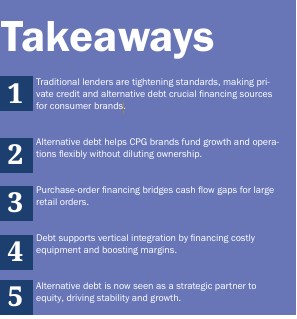
Many consumer investors would rather keep the cap table smaller and the founders happy with hopes of a larger overall exit for all by funding the working capital needs of their portfolio brands through alternative debt. Alternative debt options like asset-based lending and purchase order financing enable sponsors and CPG brands to tailor a capital structure that meets their specific needs, balancing the need for capital without excessive dilution of ownership. Asset-based lending and other alternative funding structures, when combined with equity financing can offer a powerful solution for driving growth and operational improvements for CPG businesses, with the ultimate goal of delivering increased financial stability along with investor returns. Not all alternative lenders are created equal, however. Finding the right lender that is nimble and able to creatively structure a deal is critical and can be beneficial to both clients and sponsors alike.
When disruptions and economic uncertainties rattle the markets, alternative debt solutions should be one of the first things businesses – especially high-growth CPG brands – look toward when seeking working capital to maintain their day-today operations and support future growth.
About the Author




© 2026 Secured Finance Network

