

- Forging Ahead: How Flexible ABL Financing is Fueling Growth for U.S. Manufacturers
- SFNet Announces FY27 Leadership Appointments
- The Signal in the Survey: ABL Credit Quality as an Early Warning of Systemic Stress
- Factoring Volume Rises as Industry Outlook Strengthens, SFNet Mid-Year Survey Finds
- Frozen Food's Middle Market Is an Underserved Credit Opportunity
Syndicated ABL Market Rebounds in Second Quarter as Refinancing Activity Increases
August 13, 2026
By The Secured Lender

After a relatively slow start to the year, the syndicated asset-based lending market regained momentum during the second quarter of 2026, led by a high volume of refinancing activity. While overall issuance remained slightly below last year’s record pace, all indicators are that lender demand for credit remains strong, and borrowers continue to view asset-based lending as an attractive source of liquidity amid economic uncertainty and a higher-for-longer interest rate environment.
According to LSEG, syndicated ABL issuance totaled $38.1 billion across 66 transactions during the second quarter, representing a 32% increase over the first quarter, although still 15% below the exceptionally strong second quarter of 2025. Through the first six months of the year, total syndicated ABL issuance reached $66.9 billion across 127 transactions, essentially matching the pace established during the first half of 2025.
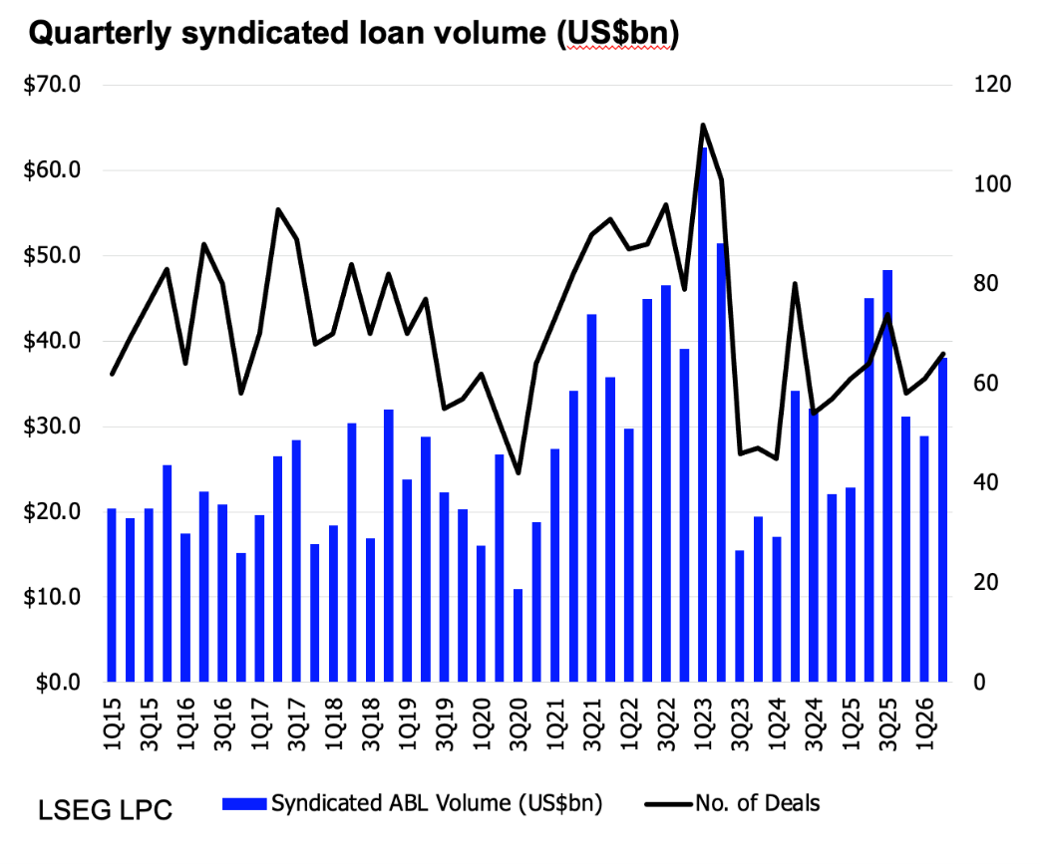
For the ABL market, the first half tells an encouraging story. While persistent inflation, elevated interest rates and ongoing geopolitical uncertainty continued to have a dampening effect on overall M&A activity, markets continued to show strength. Numerous larger corporate borrowers came to market during the first half to refinance their existing facilities and were met with strong demand from lenders resulting in borrower-friendly terms and pricing.
Refinancing Continues to Anchor the Market
The defining characteristic of the first half of 2026 was the continued dominance of refinancings vs M&A driven activity. This continues the trends from 2025. The key driver of the refinancing activity is the approaching maturity dates of the high volume of transactions that closed in 2021 through the first half of 2023. Once inflation accelerated and the broader capital markets slowed, those borrowers had little reason to return to the ABL market prior to their maturity date. They already had attractively priced and structured revolvers, generally with five-year maturities. Five years later, that dynamic is leading to an elevated level of refinancing activity. A significant portion of those facilities are reaching the point where borrowers can no longer simply wait. They must address upcoming maturities, and that refinancing requirement has become one of the most important drivers of current syndicated ABL issuance.
Second-quarter refinancing volume climbed to $26.9 billion, an increase of 28% from the first quarter, accounting for roughly 71% of all syndicated ABL issuance during the period. While refinancing activity remained below the extraordinary pace recorded a year earlier, it continues to represent the primary driver of syndicated ABL volume. Through the first half, refinancings totaled $47.8 billion, only modestly below 2025 levels
For lenders, this significant level of refinancings has allowed them to have the opportunity to evaluate their overall portfolios and potentially increase their loan exposure to clients.
The refinancing wave is also creating an important secondary effect: many facilities are returning to market looking for larger facilities than the transactions they are replacing.
The key driver of these increases has been the cumulative impact of inflation which has increased the dollar value of companies' working-capital assets. Higher selling prices translate into larger receivable balances, while higher input and merchandise costs increase inventory values. Because ABL availability is directly tied to eligible collateral, those larger asset balances can support larger borrowing bases.
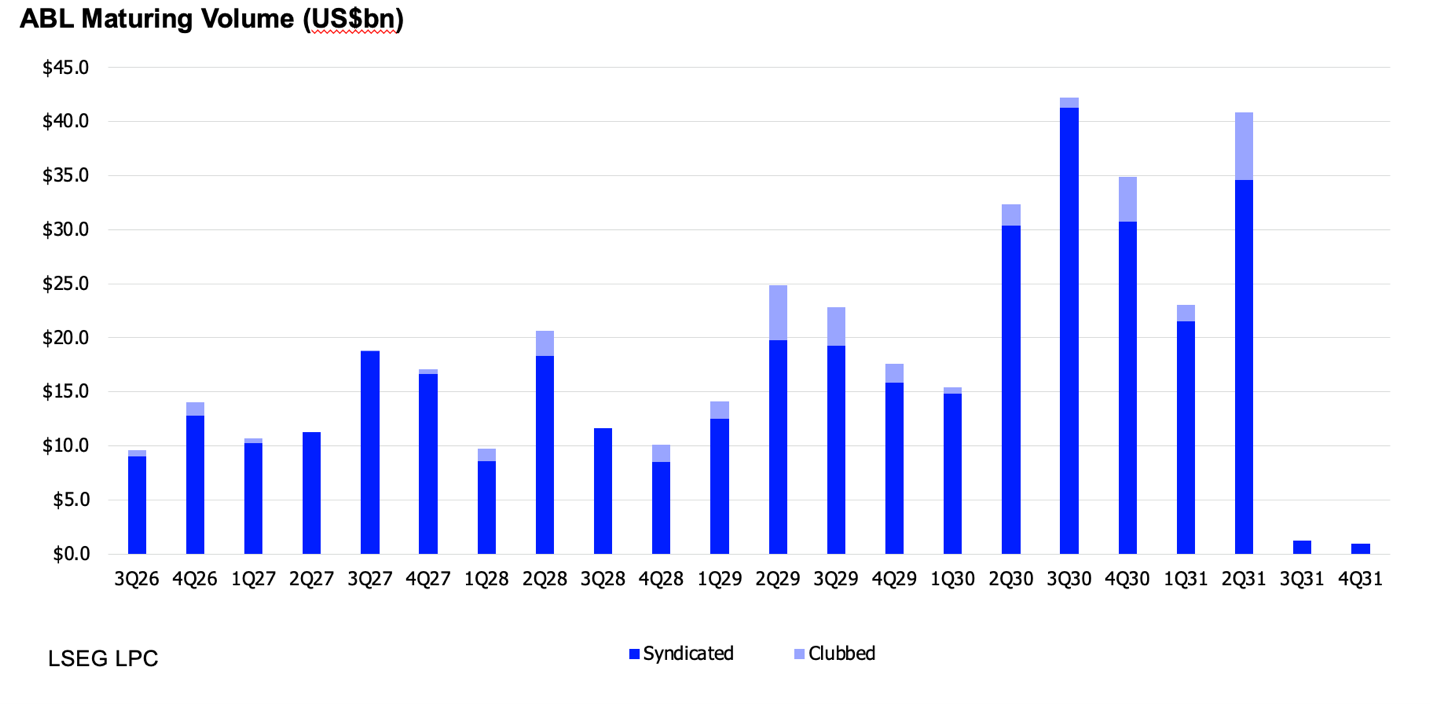
As shown below, the maturity wall for ABL has extended well into 2030 and beyond. Refinancing activity throughout 2Q 2026 significantly extended the ABL maturity wall. At the end of 2025 48.1% of outstanding commitments were scheduled to mature prior to the end of 2027. At the end of 2Q 2026 that percentage was 21.3%. That leaves $78.7 billion maturing over the next 6 quarters. An additional $47.1 billion matures in 2028.
New Money Volume Strong in 2026
Perhaps the most striking development in the first half of 2026 has come from the high level of new money volume. LSEG considers both new asset-based lending transactions and increases to existing asset-based transactions as New Money. The dominance of refinancing activity has not led to an expansion in the number of borrowers in the syndicated ABL market, but, as noted above, many of the existing borrowers have come back to market with increased facility sizes. The increased facility sizes have given lenders new lending opportunities as the companies have come back to market.
New-money syndicated ABL issuance reached $11.2 billion during the second quarter, increasing 41% from the first quarter while matching the exceptionally strong second quarter of 2025. On a year-over-year basis compared with 2024, new-money issuance increased an impressive 72%.
First-half new-money lending totaled $19.2 billion, up 10% from the same period in 2025 and marking the second-strongest first half on record behind the first half of 2022.
Corporate Borrowers Take the Lead
One of the clearest shifts during Q2 2026 occurred within borrower composition. With M&A remaining at low levels due to economic uncertainty and inflation, corporate borrowers accounted for $27.9 billion, or 73% of all syndicated ABL issuance. Corporate lending increased 63% from the first quarter, producing the strongest second-quarter corporate issuance outside of the exceptional LIBOR-to-SOFR refinancing wave experienced in 2023.
Through the first half of the year, corporate issuance increased 16% year-over-year to $45.1 billion. Sponsored lending moved in the opposite direction.
Although sponsor-backed issuance improved sequentially from the first quarter, second-quarter sponsored volume totaled only $10.2 billion, representing a 53% decline from the same quarter last year. First-half sponsored issuance declined 24% year-over-year to $21.9 billion. The divergence reflects broader trends within leveraged finance.
Pricing Remains Stable in a Highly Competitive Market
Strong demand from lenders has allowed the market to absorb the strong volume without increased pricing.
Average drawn spreads on a transaction-weighted basis remained essentially unchanged at 189 basis points during the second quarter, and average undrawn fees remained stable near 28 basis points. This is near the low point of pricing over the past several years. Dollar-weighted average drawn pricing also held steady at approximately 180 basis points, indicating that larger transactions continued clearing the market, and that they did so at relatively attractive spreads.
At the same time, pricing distribution shifted modestly toward tighter spreads. Approximately 55.3% of loans were priced at SOR + 175 bps or below, and 40.4% priced at S+150 or below. Only 12.8% were priced greater than SOFR + 275 bps or greater. Average non-use fees remained steady at 28.1 bps, with most transactions at 25 bps.
While broader debt market indexes tightened towards the end of Q2 in active markets, ABL pricing remains highly attractive on a relative value basis. Competitive conditions clearly remain healthy, especially for larger, higher-quality borrowers.
The first half of 2026 demonstrates that the syndicated ABL market remains very active and healthy. The refinancing and upsizing of transactions approaching their maturity dates has driven activity and looks poised to continue to generate strong volume for the next several quarters.
Perhaps most encouraging is that ABL continues gaining relevance within the broader leveraged finance market. As companies navigate persistent inflation, elevated interest rates and an uncertain economic outlook, collateral-based lending remains an attractive financing solution capable of providing both flexibility and liquidity. As borrowers evaluate financing alternatives, ABL continues benefiting from lower pricing, greater structural flexibility and collateral-based underwriting that can often provide larger borrowing capacity than traditional cash-flow facilities.
If current trends continue through the second half of the year, 2026 is on pace to deliver another solid year for syndicated asset-based lending, evidence of the market’s continued ability to adapt to changing economic conditions while meeting the evolving financing needs of borrowers.
Key Takeaways
- Syndicated ABL issuance rebounded sharply in the second quarter, increasing 32% from the first quarter as borrower demand and lender appetite remained strong.
- Refinancing activity continued to dominate the market, accounting for roughly 71% of second-quarter issuance as borrowers addressed upcoming maturities from prior-year facilities.
- New-money volume remained strong, supported in part by inflation-driven growth in receivables and inventory values that expanded borrowing bases and allowed many borrowers to upsize facilities.
- Pricing remained stable and competitive, underscoring sustained lender demand and ABL’s continued appeal as a flexible, collateral-based source of liquidity.



© 2026 Secured Finance Network

