

- Flexible Workplace Arrangements – Attracting and Retaining Talent in the Current Environment
- Trade Credit Insurance – More than Insurance
- SFNet’s 3rd Annual SFNet Cross-Border Finance Essay Contest Offers Industry Recognition, Chance to Be on SFNet Convention Panel
- Members of SFNet’s Factoring Committee Discuss Sources of Business, Supply Chain Issues and More
- The State of Retail: How Did We Get Here and What’s on the Horizon?
Navigating Career Transitions
March 11, 2026
By Lena M. Surilov

In the last couple of years, the finance industry has been undergoing a profound transformation, which has been driven by technology, globalization, evolving regulation, and shifting cultural expectations. At the center of this change is another powerful movement: the rise of women transitioning into new roles, leadership positions, and specialized domains within finance.
Whether moving from operational roles into front-office positions, transitioning from corporate career into entrepreneurship, moving from private practice into in-house positions, re-entering the workforce after career breaks, or shifting from traditional finance into fintech another new types of assets, women are reshaping both their own trajectories and the industry itself.
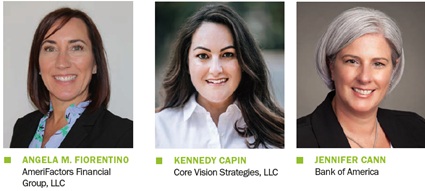
Angela M. Fiorentino, General Counsel and CEO for AmeriFactors Financial Group, LLC As general counsel, Angela handles all aspects of the company’s legal needs. She leverages that legal expertise in her role as CEO, driving innovative solutions that help clients secure the funding they need to grow and succeed. When necessary, she utilizes her litigation experience to develop and execute collection strategies aimed at recovering funds on behalf of clients and the company. Angela’s work provides benefits not only to her company, but to her clients in minimizing risk and increasing revenue.
Tell us about your career trajectory.
I began my career in the securities industry, working as a stockbroker for the first ten years of my professional life while simultaneously earning my degree in Accounting Information Systems from the University of Central Florida. During that time, I progressed from a receptionist to becoming a FINRAlicensed Supervisory Principal. That experience gave me an early foundation in financial markets, compliance, and clientfacing decision-making.
After that, I pursued law school and graduated cum laude with my Juris Doctor from the University of Miami in 2010. For the first seven years of my legal career, I focused on complex commercial and bankruptcy litigation, including class action banking defense matters. Working at a large law firm exposed me to high-stakes litigation and also reinforced the value of internal networking and collaboration within an organization.
Later, I assumed the role of general counsel and built the legal department for the subsidiaries and divisions of Gulf Coast Bank & Trust Company. In that position, I worked closely with business leaders across the organization, partnering with teams in sales, operations, credit, administration and executive leadership. That experience required clear, practical communication and the ability to adapt my approach to different personalities, priorities, and leadership styles.
In late 2023, I was appointed CEO and president of AmeriFactors Financial Group, LLC, while continuing to serve as general counsel of the civil litigation legal department at Gulf Coast Bank & Trust Company. That combination of financial, legal, and operational experience has shaped my leadership approach and continues to inform how I lead AmeriFactors today.
To what do you attribute your appointment as CEO?
I would attribute my appointment as CEO to a combination of problem-solving ability, strong people skills, and my background as a litigation attorney. My legal experience shaped the way I think and my pre-law business experience shaped the way I lead. My legal experience taught me how to quickly assess complex situations, understand risk from multiple angles, and make sound decisions under pressure. With that, I bring a collaborative leadership style that allows me to work seamlessly across organizational levels to unify diverse perspectives in strategic decision-making. These talents are all critical in the factoring business.
Tell us about the transition from the legal/lawyer role to the financial/executive role – what are some of the challenges you faced?
Making a large number of decisions very quickly, often in an ambiguous environment, was a challenging adjustment. In litigation, there is a defined process and a predictable framework. Decisions are easier to make when the possible outcomes are identifiable and the end goal is clearly established.
In factoring, I often have limited time to make intuitive decisions using imperfect information. In those situations, I rely heavily on my legal training to analyze the data available, assess risk, and think through potential consequences. Even when decisions must be made quickly, I make sure that I can articulate the support for my decision.
While transitioning to CEO, I also had the opportunity to build an internal legal department for the Gulf Coast Bank subsidiaries. Balancing that responsibility alongside the CEO role has been challenging, as each requires a different mindset and set of priorities. On a basic level, I have learned to compartmentalize effectively to make sure each role receives the attention and dedication it deserves. More holistically, that dual perspective has strengthened my leadership by ensuring legal discipline is fully integrated into the company’s strategic decisions.
Factoring has traditionally been male-dominated. How have you navigated that environment?
Even though I have spent much of my career in male-dominated fields, it can still be unnerving to be the only woman in the room. Factoring has a reputation for being a tough, demanding business, and leadership in this industry requires resilience, confidence, and decisiveness. As a woman, that often means developing thicker skin, trusting your judgment, and being willing to stand firmly behind difficult decisions.
Many of the decisions I make carry significant financial risk and real consequences for the business or for third parties. You don’t always have perfect information, but you still have to act. In those moments, I rely on thoughtful analysis of available information, experience, risk analysis, and strategy. Once a decision is made, I own it and move forward with clarity and conviction, which can be difficult since those decisions often impact other people.
I also learned early on that the most effective approach was to be myself: open, honest and direct about my perspective, especially when delivering difficult news. Building trust through transparency and consistency ultimately helped strengthen relationships and allowed the team to work more effectively together.
At the same time, I believe strong leadership requires humility. I am comfortable admitting when I have made a mistake and adjusting course when necessary. This has allowed me to lead authentically, earn trust, and guide the company forward while staying focused on long-term stability and success.
When you were initially asked to be CEO, you agreed, but only on an interim basis. Why was that?
That is a difficult question to answer, because in many ways it truly was my dream job. I was acutely aware that stepping into the CEO role meant having a significant number of people rely on me, not just professionally, but personally. That level of responsibility was intimidating. What changed for me was learning to trust my instincts. I began experimenting with doing things differently in accordance with my instincts and discovered that you can lead with strength while still being thoughtful and fair. You can build strong relationships, protect the company, and still achieve solid success.
I also built a strong internal network utilizing insight from the Gulf Coast Bank CEO and other divisional leaders. The collaborations reinforced that effective leadership does not require fitting a single mold. Ultimately, the interim role gave me the space to grow into the position and realize that my own leadership style could be both effective and sustainable.
Looking back, what advice would you give your newly appointed CEO self?
I would tell myself to believe in my abilities and trust the fact that someone else objectively saw me as the right fit for the role. That confidence does not always come naturally, especially when stepping into a position with so much responsibility, but it matters when people are looking to you for direction.
I would also remind myself that one of my strengths is navigating personalities. Being authentic, direct, and fair has always been part of who I am, and I did not need to change that to be an effective leader. Leading with authenticity builds trust and allows people to see that decisions are made thoughtfully and with integrity.
What advice would you give to other women who want to excel in the industry?
One of the most important skills you can develop is the ability to work effectively with people at every level of an organization; from entry-level employees to executive leadership. Strong leadership is rooted in communication, respect, and the ability to connect with different perspectives.
If you are transitioning into a new or significantly different role, humility is critical. Be willing to listen, ask questions, and learn from those around you. You do not have to have all the answers on day one, but you do need to be open to learning and receptive to input.
For anyone building a career, staying curious, communicating clearly, and engaging thoughtfully with partners and teams builds trust with a wide range of stakeholders. In a fast-paced, relationship-driven industry like factoring, that trust is essential. It helps align people around shared objectives and creates the foundation for long-term success.
What lessons did you learn during your transition from lawyer to executive?
One of the lessons I’ve learned in transitioning to CEO at AmeriFactors is the importance of intentionally acknowledging the team. In fast-paced environments with constant deadlines, it’s easy to move quickly from one priority to the next and not always pause to recognize the people doing the work. I’ve learned that appreciation can’t be assumed and it has to be expressed. I make a deliberate effort to follow up and acknowledge the team through various touchpoints, whether that’s one-on-one conversations, group settings, or informal check-ins. I am always learning from my team, and their perspectives challenge me to grow and lead more effectively.
Kennedy Capin, Managing Partner, Core Vision Strategies, LLC
Kennedy Capin is the managing partner of Core Vision Strategies, a differentiated field exam and collateral monitoring firm serving secured lenders nationwide. With nearly 20 years of asset-based lending experience, including as a lender with JPMorgan, across credit, originations, structuring, and operations, she brings a comprehensive lender-informed perspective to the practice. Kennedy also leads AIO Vision, a modern platform that integrates technology and specialized services to enhance transparency, efficiency, and insight for secured finance institutions.
Tell us a bit about your career and the transition you made.
For all intents and purposes, I was raised in asset-based lending. Right out of college, I joined a regional, investment bank credit training program that rotated analysts through different parts of the bank so you could figure out where you wanted to land. I chose ABL—and in many ways, ABL chose me.
Over the years, I’ve experienced just about every function that exists in an ABL shop. I’ve been junior and senior, on the sales side and the risk side, at headquarters and in emerging, or growth markets. I’ve worked domestically and internationally. Eventually, I became an executive. That breadth gave me a deep appreciation for how these platforms really work—and where the friction lives beneath the surface.
The transition came when I left JPMorgan to acquire and lead Core Vision. What has long been a boutique field exam business is evolving into a broader risk management services platform for secured lenders. It’s allowed me to take all those real-world experiences as a lender and apply them directly as an operator, building services I genuinely wish I had when I was sitting on the lender side of the table.
What prompted your decision to make a significant transition in your career?
Like many people, I had long toyed with the idea of doing something more entrepreneurial, but I always assumed that would mean leaving f inance altogether. The opportunity itself came through a long-standing relationship with the prior owner of Core Vision and his team—I had been their client.
The timing mattered just as much as the opportunity. I was coming off a particularly intense stretch: COVID, repatriating to the U.S., having twins, moving from the Southeast to the Northeast and back again, and stepping into an executive role focused on driving change. For a period of time, it felt like I was simply surviving.
When the opportunity came to step into ownership and build something thoughtfully around the realities facing today’s lenders, it felt both terrifying and exactly right. Beyond the work itself, owning the platform gave me control over my time and priorities in a way that better fits my life and my family. Looking back, it’s as though one door was quietly closing—even as I desperately tried to hold it open—while another was opening to where I needed to go.
What was the most challenging part of the transition, and what skills or relationships proved most valuable in navigating it?
One of the biggest shocks was the sheer change of stimuli. I went from encountering people all day, every day—and waking up to a hundred emails each morning, a stacked calendar each day—to no people (I work from home or the road), no meetings, and maybe, five emails. I never thought I thrived on chaos, but apparently there’s a slightly unwell version of me that does.
What I learned, though, was to embrace that space for what it became: time to read, think, plan, and be intentional. Strategic planning and reflection were things I had underemphasized before as an executive, but they’re essential to creating real, positive change—and honestly, to my own wellbeing.
The most valuable asset through all of this has been my relationships. Colleagues, mentors, and friends showed up in ways that still surprise me—asking my opinion, making introductions, trusting me with business. I’m not exaggerating when I say I’ve cried on at least one or two people out of sheer gratitude. Those relationships made the transition not just possible, but meaningful.
How did taking this step reshape the way you think about leadership, risk-taking, or long-term career growth— particularly as a woman in the industry?
I’ve become much more comfortable in my own skin. I no longer feel the need to mirror someone else’s leadership style or prove myself in ways that don’t feel authentic. I feel—deep in my bones—that I’m in the right place at the right time. What energizes me most now is building alongside people who want to hustle with me and working with clients who genuinely see the value in what we’re doing—those moments when someone says, “That’s exactly what I need. When can we start?”
And while every day certainly isn’t sunshine and rainbows, my work supports my lifestyle better. As a mother of young children, having real control over my schedule matters. I can be present when I need to be and fully engaged at work when it counts. That balance has made me a better leader, a better operator, and honestly, a happier person.
Looking back, what advice would you give to other women in secured finance who may be considering a similar pivot, but are hesitant to make the leap?
If the idea has entered your mind, don’t be quick to dismiss it. Marinate on it. The hesitation usually isn’t about capability— it’s about uncertainty. So get very clear on why you want to make the move and what problem you feel compelled to solve, or are solving with the move. Surround yourself with people who will be honest, not just supportive. And don’t wait for the moment to feel risk-free—it’ll never come. Confidence comes from execution.
Jennifer Cann, Managing Director, Head of Retail Finance Group, Bank of America
Jenn Cann is based in Boston and manages the ABL Retail Team responsible for credit, monitoring and strategic development of approximately 80 client relationships with over $25 billion in managed commitments. Jenn has significant experience in all aspects of secured lending including underwriting, credit & portfolio management along with workout & bankruptcy.
Tell us a bit about your career and the transition you made.
I began my career at Gordon Brothers immediately after college, where I held a variety of roles over my tenure before transitioning into their lending platform. That shift introduced me to retail asset-based lending, an area I remained committed to as I continued my career at Wells Fargo, spending more than 20 years in the retail lending team. In early 2022, I joined Bank of America’s Retail Finance Group as head of portfolio, marking a significant and exciting new chapter in my professional journey.
What prompted the move?
The decision to make a change was not an easy one. I loved my role and the colleagues I worked closely with for many years. However, the COVID period reshaped many of my personal and professional priorities. As I approached 50 and my children were independent, I recognized it was the right moment to embrace new challenges. I didn’t want to look back and wonder whether I had missed an opportunity simply because I was hesitant to step outside my comfort zone.
What was the most challenging part of the transition, and what skills or relationships proved most valuable in navigating it?
Even though the role itself was similar, the biggest challenge was establishing my brand within a new organization. I needed to build trust and credibility with my new team, senior management, and our risk and operations partners, demonstrating my leadership style and approach to managing risk. My longstanding relationships with third-party advisors and fellow ABL lenders proved invaluable. I rely on this network regularly for insights, problem solving, and perspective. These relationships continue to be essential, even small issues often benefit from trusted outside viewpoints.
How did the transition shape how you think about leadership, risk taking, or long-term growth—especially as a woman in the industry?
I am grateful that I took the leap. The move pushed me outside my comfort zone and ensured I would never have to wonder “what if”. Since joining Bank of America four years ago, I have advanced to Group Head of the Retail Finance Team and have become an active member of the broader leadership team. Having a seat at the table is vital not only to champion women’s advancement but to foster an inclusive environment that supports a wide range of individual needs and career paths. Taking that risk opened the door to new opportunities, deeper relationships, and a stronger sense of personal and professional fulfillment.
Any advice for women in secured finance who may be considering a similar pivot, but feeling on the fence?
Many women carry significant responsibilities, both professionally and personally, which can make change feel even more daunting. We often prioritize the needs of others before our own. However, investing in our own growth is essential. My advice is to trust your abilities, embrace the opportunities that challenge you, and take the calculated risks that can propel your career forward. The reward often follows the willingness to take that first step.
Please click here to view this article as it appears in the print edition of the magazine.
About the Author




© 2026 Secured Finance Network

