

- Interview with John Nooney, Mark Pickering and Charlie Perer of SG Credit Partners
- The Digital Transformation is Severely Disrupting Retail: The Time for Action is Now
- Top 5 Invoice Finance Frauds
- The New Collateral Frontier: How Secured Finance Is Winning Over Unlikely Industries
- SFNet Advocacy Alert: CFPB Section 1071 Rule Could Place Burden on Financial Institutions—ACTION REQUIRED
Celebrating Women in Credit: A Q&A with Industry Leaders
March 18, 2026
By Michele Ocejo

To read this article as it is published in The Secured Lender's March issue, please click here.
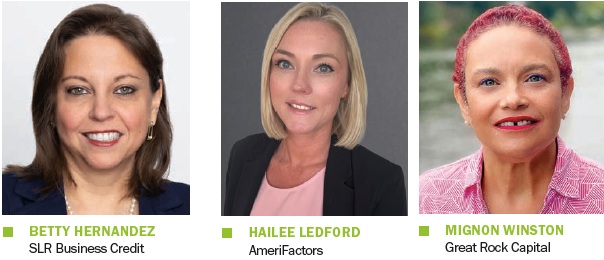
In this insightful Q&A, we feature three remarkable women credit professionals who have made significant strides in their careers. Betty Hernandez, executive vice president/chief credit officer at SLR Business Credit; Mignon Winston, vice president/underwriting team leader at Great Rock Capital, and Hailee Ledford, vice president of client relations at AmeriFactors, share their experiences, challenges, and successes.
Betty Hernandez, Executive Vice President/Chief Credit Officer, SLR Business Credit
Tell us about your career trajectory.
After graduating from Rutgers University, I started my career in a credit training program in New Jersey at First Fidelity Bank, a mid-sized regional bank. After nine months of classroom training, I was rotated through various departments to support lenders as an underwriter. There I was exposed to many different types of lending facilities and borrowers including non-profits, wholesalers, distributors, real estate and leasing. In July 1990, at the end of the two-year program, I was placed in the bank’s asset-based lending department. This department was headed by Ted Kompa, with Jeff Goldrich, Dan Tortoriello and Mike Coiley as team leaders. My role was account executive, but before I was given accounts to handle, Ted wanted me to get field exam experience. I was sent out with various field examiners under the tutelage of Ira Wolfe, the audit manager. I audited staffing companies as well as manufacturers and distributors prior to becoming an account executive.
In 1995, Ted and Jeff had an opportunity to leave First Fidelity (which was soon to become First Union and now Wells Fargo) to start up an independent finance company called Business Alliance Capital Corp. (BACC). I vividly remember Jeff’s farewell speech, as he had just turned 40 and I was about to have my second child. He discussed turning 40, leaving a stable bank job to start up a new independent finance company with no borrowers day one. I, too, had no idea what the future would hold as everything had been changing so rapidly.
After working briefly at PNC Business Credit, I re-joined my former colleagues at BACC as an underwriter. In 2005 BACC was sold to Sovereign Bank (later to become Santander Bank). Eventually Santander decided to exit the BACC portfolio, and I became a team leader in their workout department working for Tony Cortese and later Mike Maiorino. In 2010 Jeff and Dan had successfully raised equity and had obtained a leverage facility to re-start on their own again. I joined them, and a few others, to co-found North Mill Capital LLC and serve as the firm’s chief credit officer.
In 2017, we were acquired by SLR Investment Corp. (Nasdaq: SLRC). We were later re-branded to SLR Business Corp., and thanks to the support provided by our parent company, we’ve been able to grow our portfolio exponentially. In 2010, when we started, we had 16 loans with $19 million outstanding. Today, as a result of six acquisitions and organic growth, we have over 150 borrowers and $1 billion in credit facilities under management. I am responsible for credit quality and the performance of the portfolio. I oversee all new fundings. I enjoy meeting with customers face to face and touring their facilities. I really enjoy the team and culture we have built. I am very fortunate to have been working with my mentors and friends for over 35 years.
Can you share a specific moment when you had to make a difficult credit or portfolio decision? How did you balance risk, instinct, and accountability in that call?
Each and every day, we are making credit and portfolio decisions and asking “Should I approve this advance today” It’s an easy decision if the borrower is “in formula” and there are no “red flags,” i.e. the collateral is performing well, the company’s collateral and financial reporting is adhering to the requirements outlined in our loan agreement, the field examinations have been “clean.” However, it is more complicated when a borrower is tight on availability and is asking for just “a little more.” For example, they could ask for a temporary reprieve of the cross-aging or other ineligible rules that we have agreed to. It always seems like those are the days that the borrower needs money for payroll or to pay a critical vendor. It is in those moments that I ask myself, “How am I going to get back into formula if I make this advance?” Is the borrower’s response plausible? For example, can “more sales” or “collections of a specific account debtor payment” be achieved? I also ask: “For how long is this request going to be needed?”, “Is this a permanent situation where if I ‘bend this rule’ we will never be able to go back to the originally intended structure or is it truly temporary?”, “Do we have additional collateral or a block in availability that is effectively covering this request?”, and “Is this a constant request (and red flag)?” All these questions are contemplated and evaluated when making those tough daily decisions to lend.
Tell us about a challenging client situation. What was at stake, and how did you navigate the relationship while protecting your institution?
I treat every loan as if it was my money. I think most lenders do; no one ever wants to “make a bad loan” or “lose money.” When faced with a complex workout, you must navigate the situation carefully to minimize the potential loss. We often receive calls from borrowers that are losing money or tight on availability, need working capital, and have nowhere else to turn to. For smaller, privately owned businesses, owners are usually already “all in.” In the cases where business owners can come up with some cash to infuse or additional collateral to pledge, we will work cooperatively to resolve the temporary situation. We are always flexible and look for ways to help and provide time to the borrowers to present their plan to us. We are aware that things change due to various issues, including economic business conditions.
We are in business to support turnaround plans and have a high threshold of tolerance for borrowers’ struggles. However, often there is no more liquidity available to bridge the losses and we are asked to plug the hole. We are lenders, not owners. We lend money and we want it back with interest and all earned fees.
I recently had a situation where a business owner took bad advice from a family member to grow their business into other areas that he could not run. The founder was a truck driver who started his business making local deliveries from the port to its intended drop-off. As the years went on and his business grew, his wife also obtained her CDL license and began driving a truck. Once they had their second child, she decided to stay home and he began hiring drivers. His business kept growing and, eventually, his children became involved in the company. One of his children had visions of expanding the company nationwide with a brokerage and long-haul strategy. He hired an entire marketing department to make cold calls. To fulfill the new orders, he bought new trucks and his dad signed for these personally. He made his father buy land in the hope of building another hub. Essentially, he put the “cart before the horse.” We entered into an asset-based line of credit. The business started to wane and, unfortunately, the overhead burden was just too much to handle. His son left the business, and the founder was left to deal with the fallout.
In a situation like this, we don’t want to alienate the owner. We worked with the founder and the newly hired business manager. We requested weekly cashflow budgets depicting where our collateral was in relation to the receivables being created. This 13-week cashflow is key for us to determine how much liquidity the company will need in the upcoming weeks. It also tells us what sales and collections the borrower is expecting. We asked pertinent questions such as, “Are your payroll taxes current?” This is important as payroll taxes can prime our first lien. “Are the insurance payments, rent, leases and payroll up to date?” Internally we prepared a liquidation analysis and performed a legal file review. We projected how much cash we can realize from the existing collateral vs. the amount of our loan, including an estimate of legal fees (which is always a challenge to predict). We increased the number of verifications we performed and offered the company assistance with collection calls. We sent out a field examiner to review the books and records to ensure that we were receiving all collections. We communicated with the borrower frequently. In the end, the borrower was able to refinance our debt, and we were repaid our full balance including interest and fees.
Looking back on a tough deal or client outcome, what did the experience change about how you approach underwriting, portfolio monitoring, or leadership today?
I think tough deals provide good learning lessons. It is always easy to perform a postmortem and say to yourself, “This is what I should have done differently.” Lending to a tough client is always a learning experience. We just recently booked a loan where the business owner was with a bank and was not as familiar with our type of full-dominion asset-based lending. He wanted to do things a certain way and after speaking with our BDO and underwriter involved in the transaction, I knew that the monitoring of this loan would have to be assigned to the right person at our firm. It would have to be one of our team members who is particularly good at standing firm with requests and steadfast with follow-up reminders. It’s important to consider the work style of our account executives when matching them with borrowers, along with the borrower’s geographical location and industry expertise, to make the relationship as smooth and productive as possible. I take all of this into account to protect our portfolio when I assign a new deal to an account executive.
Mignon Winston, Vice President/Underwriting Team Leader, Great Rock Capital
Tell us about your career trajectory.
I spent my first nine years at a major money center bank doing middle-market cash-flow lending. I loved the rigor of middle-market lending vs. lending to Fortune 500 companies. I valued being important to a mid-sized borrower’s business. During my time with this bank, I realized that I preferred the credit side of the lending business to the relationship management or origination sides: I really like “geeking out” over determining middle-market borrower creditworthiness. I then sought out roles that were more credit intensive, which ultimately led me to join Heller Financial as a senior underwriter in its factoring group, marking my entry into secured finance. I entered the ABL realm at CIT in underwriting and portfolio management roles and subsequently worked at Wells Fargo Business Credit, First Capital (now part of Ares), and Sterling National Bank, now Webster Bank. I have enjoyed underwriting in the alternative lending space, most recently at White Oak Commercial Finance and, for the past three years, at Great Rock Capital (GRC), an asset-focused private credit firm that agents and co-lends with lending partners to fund RLOC, term loans, and full-solution financings.
Share a specific moment when you had to make a difficult credit or portfolio decision? How did you balance risk, instinct, and accountability in that call?
In my current role as an underwriting team leader at GRC, I am often called upon to synthesize large amounts of information quickly. For instance, on multiple occasions, our underwriting team has evaluated and closed co-lending transactions in several weeks to complete an agent’s syndication efforts. This quick turnaround strengthens relationships with agent lenders and positions GRC as a preferred co-lender for future transactions. As team leader, I manage the efforts of several team members to analyze extensive borrower information; enumerate all lending risks; articulate the terms under which GRC can join the credit facility to the agent; author a succinct credit approval memo; evaluate the closing documents to ensure compliance with GRC’s lending standards; and oversee the closing logistics.
Evaluating a prospective loan requires both experience and instinct. I have to understand the transaction’s risks and the borrower’s ability to comply with the proposed lending arrangement and promptly communicate any issues to GRC senior management.
During this process, I am first accountable to my firm to close transactions that will work for both GRC and the borrower. I am accountable to my team members to work together to meet all of the various deadlines—not only managing, but also serving as a player-coach. Finally, I am accountable to GRC’s goal of enhancing the relationship with the agent as a result of this transaction.
Tell us about a challenging client situation. What was at stake, and how did you navigate the relationship while protecting your institution?
In my first portfolio management role, I underwrote and managed a borrower with 100% receivable concentration: a government contractor selling exclusively to the U.S. Department of Defense. As a growing company, the borrower really should have been working with an ABL lender. However, the bank’s senior management strongly wanted the transaction and approved a cash flow line of credit that required an annual 30-day clean-up and monthly reporting. This loan structure was the lending equivalent of putting a size 10 foot into a size 8 shoe!
Prior to closing the loan, I spoke with the company’s contract officer at the DoD, who referred to the company as “one of our stars.” Over and above the monthly reporting, I kept in constant contact with the CEO about the status of existing and potential new contracts, shipments, and receivable collections. I regularly reminded him of the requirement to repay the loan in full for 30 consecutive days to comply with the lending arrangement, which was challenging given that it was a growing, non-seasonal business. Senior management at the Bank was pleased and relieved when the company successfully completed its 30-day clean-up requirement.
Lessons learned: Independent of the reporting cadence, maintain consistent contact with your borrower as to the status of the underlying business and its implications for near-term liquidity and borrowing needs. Don’t rely solely on the loan documents to stipulate the lending requirements: engage directly with the borrower’s management about upcoming deal requirements and how the company intends to comply. Be in an anticipatory mode, not a reactive mode.
Looking back on a tough deal or client outcome, what did the experience change about how you approach underwriting, portfolio monitoring, or leadership today?
Lessons learned over the years on tough deals:
- Asset based lenders focus a lot on collateral and may not focus sufficiently on the caliber of borrower management. The ability of borrower management to source/produce widgets and sell them at the right price to the right customers and collect the ensuing A/R is what gives the business its viability and the collateral its value. Borrower management should be assessed as strong, satisfactory, or weak.
- If the borrower’s CFO resigns, call them directly and ask them if there is anything going on at the company that the lender should be aware of.
- Overcommunication is always preferable to inadequate communication, both within your firm and with a borrower.
- It is imperative to perform borrower site visits on a regular basis.
- Independent of your firm’s performance review cadence, it is important to give team members ongoing feedback, both positive and constructive, so they can perform optimally in their role and meet your expectations going forward.
Hailee Ledford, Vice President of Client Relations, AmeriFactors
Tell us about your career trajectory.
Working from the ground up reflects my journey in the industry and, more specifically, at AmeriFactors Financial Group. I began my career as an account executive, inheriting a full client portfolio on my very first day. Within a few months, through dedication, hard work, and a commitment to mastering the nuances of factoring, I was promoted to senior account executive. As I took on greater responsibility and continued to deepen my industry knowledge, I earned the role of vice president of client relations. Now, eight years later, I continue to oversee daily client engagement and lead the team of account executives who support and service our entire client portfolio.
Can you share a specific moment when you had to make a difficult credit or portfolio decision? How did you balance risk, instinct, and accountability in that call?
At AmeriFactors, our mission is centered on empowering clients who may not fit the traditional bank financing model. We take pride in being a solution-driven partner, offering flexible support to help businesses grow and succeed. Many of our clients are not eligible for conventional credit facilities, but through thoughtful analysis, collaboration, and a genuine commitment to their success, we help them move forward with confidence in their funding. One example that stands out is a small business startup that handles cell tower maintenance. They approached us for invoice funding despite having limited operating history. Rather than viewing this as a barrier, we focused on the strength of the leadership, vision, and business plan including the credit worthy customers they were servicing. We structured a factoring agreement tailored to the client’s needs while responsibly addressing the additional risk associated with a new venture. This decision was rooted in the strong relationship cultivated by our Business Development team and reinforced through collaboration and ongoing trust, laying the foundation for a long-term partnership. Today, we continue to fund this client, and the relationship has proven to be a rewarding success for both the client’s growth and AmeriFactors’ original investment.
Tell us about a challenging client situation. What was at stake, and how did you navigate the relationship while protecting your institution?
Factoring is a specialized form of financing in which we underwrite our clients’ customers rather than the clients themselves, among other things. One of our current clients has developed into a relationship that has delivered meaningful value for both the client and AmeriFactors, even though the engagement required careful evaluation in its early stages. With many of our utilities and construction-service clients, from the outset, there is a high level of trust involved, as our success depends on the client’s ability to consistently deliver on commitments, meet deadlines, and manage obligations responsibly. Through experience, we have established effective checks and balances that provide the confidence needed to fund our clients efficiently, support uninterrupted operations, and ensure the collectability of our advances. This process has allowed this client to stay on track for their commitments while increasing sales, and facilitating a diversified portfolio of accounts, allowing us to further manage risk by financing and closely tracking multiple projects across several creditworthy customers. The result is a collaborative partnership that reflects AmeriFactors disciplined approach to risk management and commitment to helping our clients succeed.
Looking back on a tough deal or client outcome, what did the experience change about how you approach underwriting, portfolio monitoring, or leadership today?
Looking back on challenging deals, the biggest change in my leadership approach has been a deeper appreciation for collaboration, creative problem-solving, and personalized client support. One of our clients joined us with years of net losses, although they were manufacturing parts for some of the most prestigious automobile makers in the world. After looking at their numbers and developing an approach that utilized their existing invoicing processes to confirm the validity of the accounts, we were able to increase their cash flow immediately based on an increase in sales, allowing them to timely grow and expand operations. These experiences have reinforced the importance of working closely across teams to explore tailored funding structures that align with client needs while remaining within our risk framework. Rather than viewing complexity as a limitation, I see it as an opportunity to design strategic solutions that support growth. These situations have also strengthened how I approach underwriting and portfolio monitoring. By combining analysis and open dialogue with internal teams, clients, and partners, we are able to structure agreements that leverage client legal protections, establish clear expectations, and mitigate risk on both sides. Providing hands-on, responsive support allows us to act as an extension of our clients’ businesses, helping them navigate challenges with confidence while maintaining strong safeguards. My experience across a wide range of industries has given me the knowledge to trust my intuition, resulting in well-structured partnerships that deliver long-term value for our clients and for AmeriFactors.
About the Author




© 2026 Secured Finance Network

