

- Interview with Eileen Kowalski, Recipient of SFNet's Harry H. Chen Instructor of the Year Award
- Bridging the Gap from Predatory Debt to Legacy Banking
- SG Credit Announces Hiring of Chris Jensen as Managing Director, Head Of Underwriting and Portfolio Management
- When Structure Meets Opportunity
- Legacy Corporate Lending Names Anthony Masci Chief Risk Officer
ABL Primer for Students, Interns and Industry Newcomers
August 10, 2026
By Eileen Kowalski

This summer, I had the pleasure of teaching two cohorts of the inaugural Secured Finance Network 2026 Summer Intro to Asset-Based Lending (ABL) for College Interns. As a follow-up, this is a practical introduction to asset-based lending, collateral analysis, borrowing bases, fi eld examinations, and loan monitoring for interns, students and industry newcomers unable to attend, or as a reference for those that attended.
This primer translates the core concepts from the introductory ABL training materials into a practical technical reference that explains how lenders evaluate collateral, structure credit facilities, monitor risk, and respond when borrower performance changes.
What Is Asset-Based Lending?
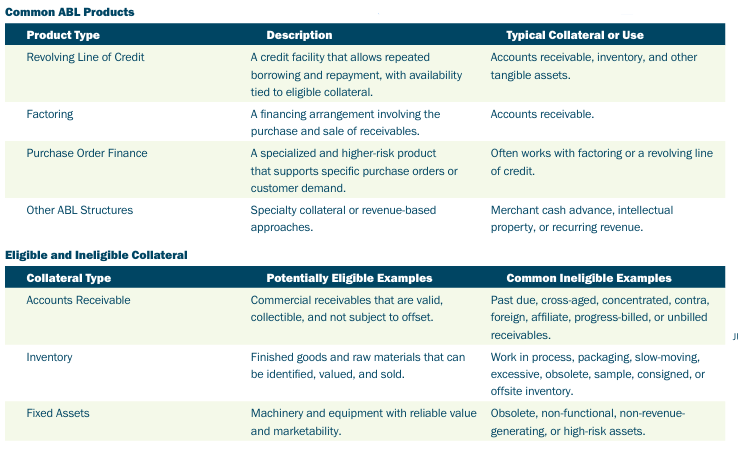
ABL is a form of financing in which the amount a borrower can access is tied primarily to the value and quality of specific assets. These assets usually include accounts receivable, inventory, machinery and equipment, cash, intellectual property, or insurance proceeds. In an ABL facility, the lender focuses on whether collateral can be converted into cash if the borrower defaults or becomes insolvent.
Unlike traditional cash-fl ow lending, which places greater emphasis on enterprise cash generation and fi nancial covenants, ABL relies on collateral monitoring and borrowing base availability. This makes ABL especially useful for businesses with working capital needs that fl uctuate with sales, inventory levels, receivable collections, seasonality, or growth.
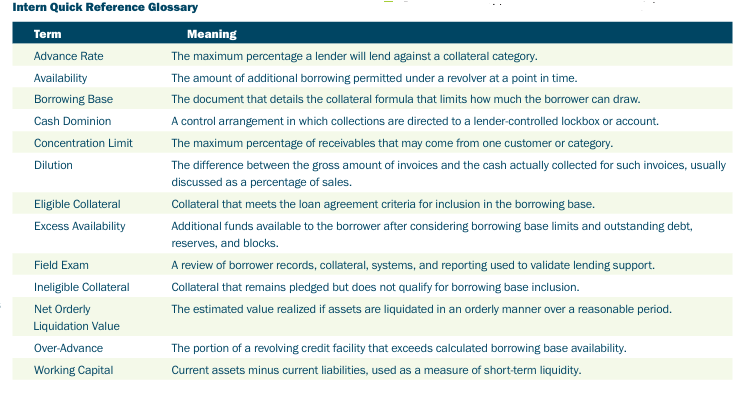
ABL and factoring are alternatives to conventional financing and can improve liquidity by linking borrowing capacity to the borrower’s working capital assets. As eligible receivables and inventory increase, borrowing availability may also increase. As those assets decline, availability may contract. This structure encourages more disciplined working capital management and can provide flexibility during performance setbacks, growth initiatives, expansion plans, or capital structure changes.
Collateral Fundamentals Collateral is an asset pledged by the borrower to support repayment of a loan. For ABL purposes, collateral is valuable only to the extent that the lender can monetize it in a default or insolvency scenario. The most common collateral categories include accounts receivable, inventory, fixed assets, cash, intellectual property and insurance proceeds.
Accounts Receivable as Collateral
Accounts receivable are often a primary ABL collateral class because they are expected to convert into cash in the near term. Advance rates commonly range from 70% to 90% of eligible receivables, although lower rates may be appropriate depending on risk. Lenders evaluate dilution, trends, customer concentration, diversification, overall customer credit quality and specialized receivable characteristics such as government, foreign, affiliates, or contra accounts.
Receivable testing and verification are important controls. Field examiners, using various AR sampling, may test whether receivables exist, are valid, are fully collectible, and whether disputes or discrepancies exist. Significant disputes, offsets, or unresolved discrepancies should generally be treated as ineligible until resolved.
Inventory as Collateral
Inventory is typically more difficult to convert into cash than accounts receivable because goods must often be finished, sold, and collected before cash is realized. As a result, inventory advance rates are usually lower than receivable advance rates and may range from 20% to 75% of net orderly liquidation value. Lenders consider the potential value of raw materials, work in process, finished goods and in-transit inventory, plus whether the borrower maintains a reliable perpetual inventory system. Common ineligibles include packaging, consigned goods, offsite inventory, perishables and certain specialized products.
Appraisals are often used to validate inventory and equipment values. Common valuation bases include forced liquidation value and net orderly liquidation value. Appraisals may discuss value characteristics, current market conditions, seasonality, liquidation time frames and asset-specific considerations.
Borrowing Base Mechanics
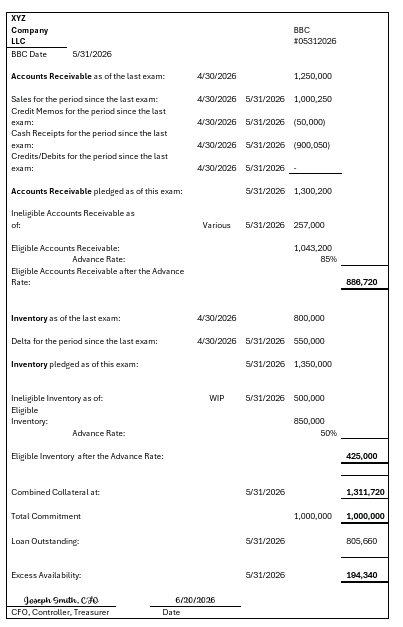
The borrowing base is a document prepared periodically by the borrower using the collateral formula to determine how much the borrower may draw under a revolving facility at a specified reporting period. It generally applies advance rates to eligible collateral and may include reserves, blocks, caps, or other limitations. Availability is typically calculated as the lesser of the borrowing base or the loan commitment, minus outstanding borrowings, letters of credit and other credit extensions. See a simple example on next page.
Field Examinations A field examination (see page 54 for a primer on field exams) is a review of a borrower’s assets, liabilities, facilities, books, records and collateral reporting. Field exams help lenders independently validate what the borrower represents and warrants. They reduce the risk of misrepresentation, identify reporting errors and support ongoing portfolio monitoring.
The scope of a field exam depends on the proposed or existing credit facility and/or the existing collateral using a clearly defined review period. A survey exam focuses on underwriting a prospective facility, while a recurring exam confirms whether the borrower’s financial or collateral condition has changed since the survey or prior review.
Loan Structure and Documentation
A sound loan structure should define the purpose of the facility, source of repayment, adequate amount, appropriate term, appropriate pricing and framework for monitoring. From the lender’s perspective, the goal is to be repaid in full while establishing a framework under which the borrower can continue seamlessly operating. From the borrower’s perspective, the goal is to maintain access to liquidity with minimal interference in normal business operations.
Typical ABL Documents
Loan and Security Agreement: Governs the lending relationship, grants the lender a security interest in collateral and defines financing terms.
Promissory Note: Evidences the borrower’s debt obligation.
Guaranty: Provides an additional repayment obligation from a guarantor if the borrower defaults.
Intercreditor Agreement: Allocates rights among lenders with interests in the borrower’s collateral.
Landlord or Bailee Waiver: Helps preserve lender access to collateral located with a landlord or bailee.
Insurance Documents: Evidence lender loss payee status or other insurance protections.
Deposit Account Control Agreement (DACA): Provides lender control rights over deposit accounts, often connected to cash dominion.
Covenants and Monitoring
Covenants are contractual requirements that help the lender monitor risk and establish expectations for borrower conduct. Affirmative covenants require the borrower to take or perform certain actions. Negative covenants restrict specific actions. Financial covenants measure performance through tests such as debt-to-equity ratio, interest coverage, cash flow, EBITDA, or operating expense levels. Key monitoring metrics include liquidity, excess availability, borrowing base trends, days sales outstanding (DSO), days inventory outstanding (DIO), days payable outstanding (DPO), dilution, concentration, collateral reporting accuracy and compliance certificate results.
Problem Loans, Defaults, and Remedies
A default occurs when the borrower violates a provision of the financing agreement. When problem loans arise, lenders identify available solutions, evaluate advantages and disadvantages, and coordinate with credit, portfolio management, legal counsel, appraisers and other specialists as needed. The objective is to be proactive rather than reactive.
Important concepts include preserving lender rights, understanding available remedies, obtaining legal input on perfection and priority, considering third-party rights, and recognizing when a workout can be negotiated versus when bankruptcy-related strategies may be necessary.
This article is for general information purposes only and is not intended to provide legal, tax, accounting or financial advice.
This article was written with the assistance of an AI tool.
To read this article as it appears in our July/August Issue, please click here.
About the Author




© 2026 Secured Finance Network

