Latest Wolters Kluwer Risk Survey Reveals Persistent Compliance Challenges for Banks
December 14, 2022
Source: Wolters Kluwer
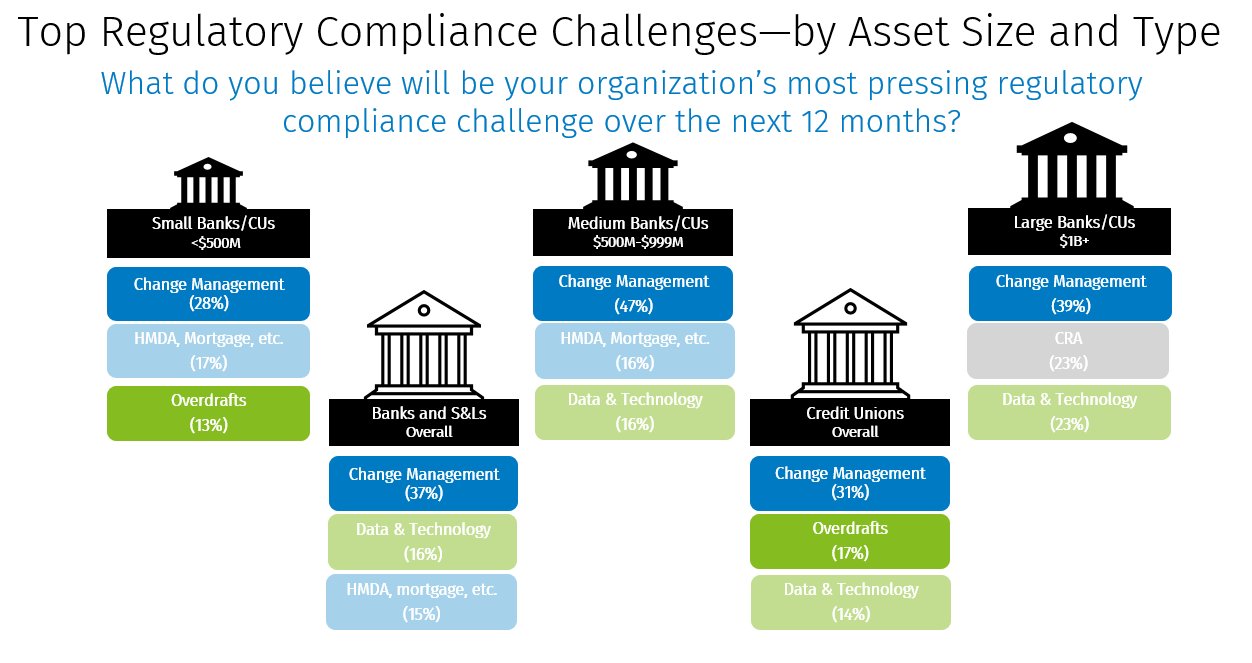
Against the backdrop of an evolving banking and technology landscape, strong economic headwinds, and a persistent wave of regulations to manage, U.S. banks and credit union are fairly united in pointing to regulatory change management as their single most pressing regulatory challenge, according to Wolters Kluwer Compliance Solutions in its 10th annual Regulatory & Risk Management Indicator survey.
“Unquestionably, this year’s survey findings point to the critical role that a robust regulatory change management program—particularly one featuring an up-to-date regulatory library—plays in helping ensure compliance and addressing risk across a lending organization,” said Timothy R. Burniston, who is Senior Advisor for Regulatory Strategy with Wolters Kluwer Compliance Solutions.
Wolters Kluwer says that it began the Indicator back in 2013 with the aim of “taking the pulse” of the U.S. banking industry, measuring lenders’ regulatory and risk trends and concerns, along with anticipated and actual regulatory impacts affecting institutions, and banks’ relative abilities in managing risk. Regulatory factors, together with input from survey respondents, help to generate a “pain index” snapshot of major risk and regulatory challenges facing U.S. banks.
Elements that comprise the list of key compliance and risk challenges are many, according to a Wolters Kluwer press release. Survey respondents cited the ability “to manage risk across all lines of business” as their top concern (59%). Following this was the ability “to maintain compliance with changing regulations” (58%), to keep track of regulations (55%) and to demonstrate compliance to regulators (54%), all factors up notably over last year’s survey.
Concern about new regulations jumped considerably, from a score of 67 in 2021 to 114, a 47-point increase. Banks anxiously await a final rule on Community Reinvestment Act (CRA) modernization, along with the release of final rules on small business lending data collection, Section 1071 of the Dodd Frank Act. Both regulations are expected to have a significant impact.
The company notes that another area of increasing angst are concerns about the continuing use of manual processes and spreadsheets to perform regulatory compliance functions. Eighty-five percent of respondents were “sometimes or often” concerned by manual processes’ continued prevalence in their organizations, versus only nine percent who indicated their institutions rarely used manual processes.
A new area of exploration in this year’s survey focuses on lenders’ use of digital technologies to support their businesses. Nearly three-quarters of respondents indicated they have made some progress with digitizing their lending capabilities, although only 28% indicated their institutions have made significant progress or are fully digitized.
“Clearly, the banking industry increasingly recognizes the upsides in employing and more fully leveraging digital processes and automation, particularly given their impact in reducing or eliminating time-consuming and less accurate manual processes from their everyday workflows,” said Steven Meirink, Executive Vice President and General Manager, Wolters Kluwer Compliance Solutions. “Ultimately, embracing digital transformation can help improve the customer experience, foster inclusivity, and allow lenders to more effectively compete.”
In considering the benefits of automation to manage regulatory change, respondents ranked in descending order of importance the following capabilities, led by maintaining a regulatory compliance library (50%), connections that map to other elements of an institution’s compliance program (43%) and speed (37%), with analysis (36%) and technology (35%) rounding out the list.
Among the top obstacles cited in implementing effective compliance programs, 54% ranked manual compliance processes as a “7” or higher concern on a 10-point scale, a nine-point increase over 2021, followed by inadequate staffing (44%), and too many competing priorities (38%). Perceptions of regulatory scrutiny of fair lending programs reflected a slight uptick with 16% of respondents observing a considerable increase in fair lending scrutiny, rising 2% over 2021.
Leading the issues respondents identified as being “Very Concerned” or “Somewhat Concerned” about are the looming Section 1071 small business lending data collection rule. Next are Bank Secrecy Act and Anti-Money Laundering (BSA/AML) rules (63%); fair lending laws (63%); Beneficial Ownership, UDAAP rules and CECL (Current Expected Credit Losses) requirements (all tied at 62%). CRA modernization (58%) and state regulatory rules (57%) closed out the list.
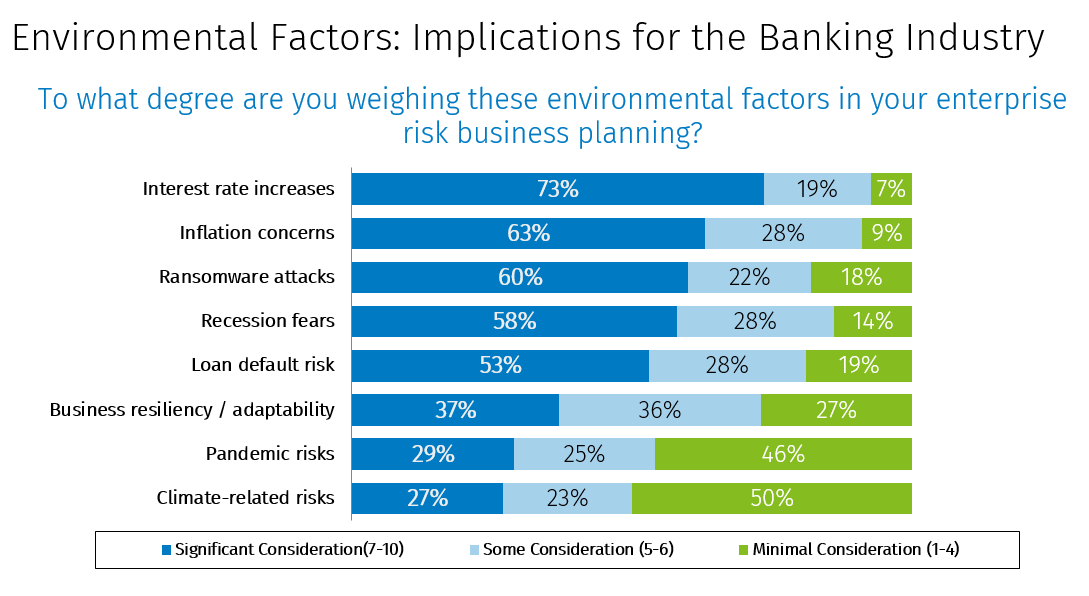
Looking forward to 2023, top risk management priorities identified include cybersecurity (72%), compliance risk and credit risk (both at 51%), followed by operational risk and third-party risk (27% and 16%, respectively).
Wolters Kluwer (AEX: WKL) is a global leader in professional information, software solutions, and services for the healthcare; tax and accounting; governance, risk and compliance; and legal and regulatory sectors. We help our customers make critical decisions every day by providing expert solutions that combine deep domain knowledge with specialized technology and services. Wolters Kluwer reported 2021 annual revenues of €4.8 billion. The group serves customers in over 180 countries, maintains operations in over 40 countries, and employs approximately 19,800 people worldwide. The company is headquartered in Alphen aan den Rijn, the Netherlands.