Fitch Ratings-Chicago/New York-06 January 2022: Heightened political and regulatory scrutiny of large bank mergers and acquisitions (M&A) could lead to increased execution risk for future deals and for banks with in-process transactions, Fitch Ratings says. However, we expect small and mid-sized regional banks to continue to announce new deals despite growing regulatory scrutiny that could result in delayed closings or even the potential termination of deals.
Banks are expected to continue to pursue growth through acquisitions into 2022, driven by a desire for increased scale and enhanced franchise strength either through new geographies or by growing market share within their existing footprint. Moreover, increased scale can alleviate growing technology and compliance costs. Bank M&A has historically been neutral or negative for credit ratings over the near to medium term, mainly due to integration and execution risks. However, any ratings implications would be evaluated in the context of a bank's overall strategy, price paid and appropriateness of deal assumptions.
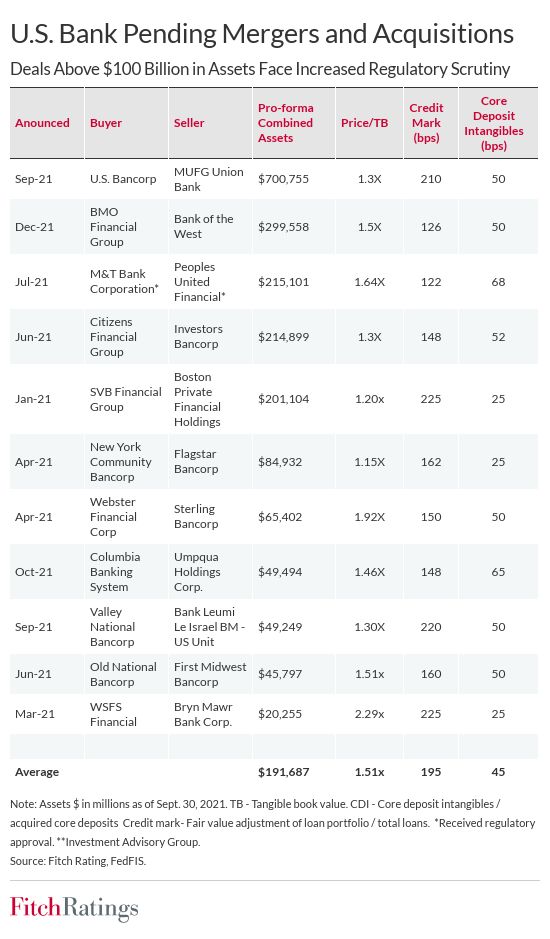
In July 2021, the administration issued an executive order demonstrating renewed interest in antitrust enforcement, with a specific mention of the Bank Merger Act of 1960. Politicians are increasingly debating the rules and regulations around bank mergers, with potential moratoriums on deals over $100 billion. Deals that could be impacted by such a moratorium include U.S. Bancorp’s acquisition of MUFG Union Bank; Bank of Montreal’s acquisition of Bank of the West, M&T Bank’s acquisition of People’s United Financial and Citizens Financial Group’s merger with Investors Bancorp. However, First Citizens/CIT and other deals have recently received approval.
To the extent an announced transaction is delayed, deals can lose momentum and waste firms’ time and resources, often at the expense of strategic plans and long-term goals. Failed mergers could also reduce potential earnings and ratings upside and may exacerbate key-person risk if management or staff seek opportunities elsewhere.
Despite stepped up scrutiny, U.S. banks continued to announce new transactions throughout 2021, albeit with pricing moderating from the highs of the first half of the year. The median price to tangible book for bank acquisitions has been around 1.5x during 2021, which is above 2020 levels but in line with historical averages, while the associated average credit mark of 1.55%, which reflects expectations for future losses, is slightly above historical norms
Ratings considerations include potential integration risks associated with M&A, the strategic and financial benefits or detriments and an issuer’s track record of executing on prior transactions. Execution risks can be meaningful for M&A, with potential for technical integration issues and cultural disruption. The deal economics of many transactions rely on estimated cost reductions.
Mergers that provide appropriate risk-adjusted return on capital or provide enhancements to a bank's business profile can be supportive of credit in the long run. M&A can improve funding profiles, deposit franchises and cost of funds. These considerations can be meaningful for smaller regional banks lacking resources to fund increasing technology spending to overhaul legacy systems against a backdrop of growing cyber risk. Small and mid-sized regional banks, whose business lines, geographic and loan category concentrations and franchise strength vary considerably, may be more incentivized to pursue M&A either through a whole bank acquisitions or as a target themselves.
Contacts:
Christopher Wolfe
Managing Director, North American Banks
+1 212 908-0771
Fitch Ratings
300 West 57th Street
New York, NY 10019
Brian Thies
Associate Director, North American Banks
+1 312 606-2316
Laura Kaster, CFA
Senior Director, Fitch Wire
North and South American Financial Institutions
+1 646 582-4497